
Back To Blogs
_97490_orig)
AAR 2025 Boston
An Update from the Field
12/09/2025
I've just returned to Switzerland from the 2025 Annual Meeting of the American Academy of Religion in Boston. It was an exciting and wonderful opportunity to meet with colleagues and friends who I haven't seen since last year in San Diego, and to share the methods of Engaged Jain Studies across multiple disciplinary communities. Here I will share some of the highlights of this annual academic ritual.
While there, I attended panels hosted by the yoga in theory and practice unit (Alba Rodríguez Juan, UC Riverside, and I are co-chairs), the animals and religions unit, the indigenous religious traditions unit, the music and religion unit, the tantric studies unit, Christian spirituality unit, the mysticism unit, and the contemplative studies unit. I also attended the 2025 DANAM Conference at the AAR (I am a member of their steering committee as well). And on Friday night, the Jain Center of Greater Boston kindly hosted a vegan dinner for the Jain Studies scholars where we were able to meet members of the community and see the center’s many publications.
At DANAM, I had the great pleasure of organizing and presiding over a panel called "Compassion as a Path to Freedom" which was intended to address the question of how compassion leads to freedom in the Dharma traditions. This panel, featured among the “riches” of the 2025 AAR in Publisher’s Weekly was inspired by the AAR's "freedom" theme for 2025, as well as our own compassion studies initiative at Arihanta Institute funded by the Uberoi Foundation. Here I was struck by how each of the four dharma traditions expresses compassion as a fundamental spiritual practice on the path toward liberation, and yet each tradition does so according to their own theological and soteriological principles.
Alba Rodríguez Juan (UC Riverside) did an excellent job describing how Yaśovijaya understands compassion to be a practice which entangles one in saṃsāra while simultaneously liberating one from it when practiced according to particular Jain principles. Eileen Goddard (UCSB) carefully showed us how compassion fits within Gauḍīya Vaiṣṇava devotional theology. Nirinjan Khalsa (LMU) laid out the Sikh tradition's conceptualization of a compassionate, sage warrior. Finally, Jonathan Dickstein (Arihanta Institute) raised some important questions about the relationship between knowledge and compassion and spiritual practice across the four dharma traditions.
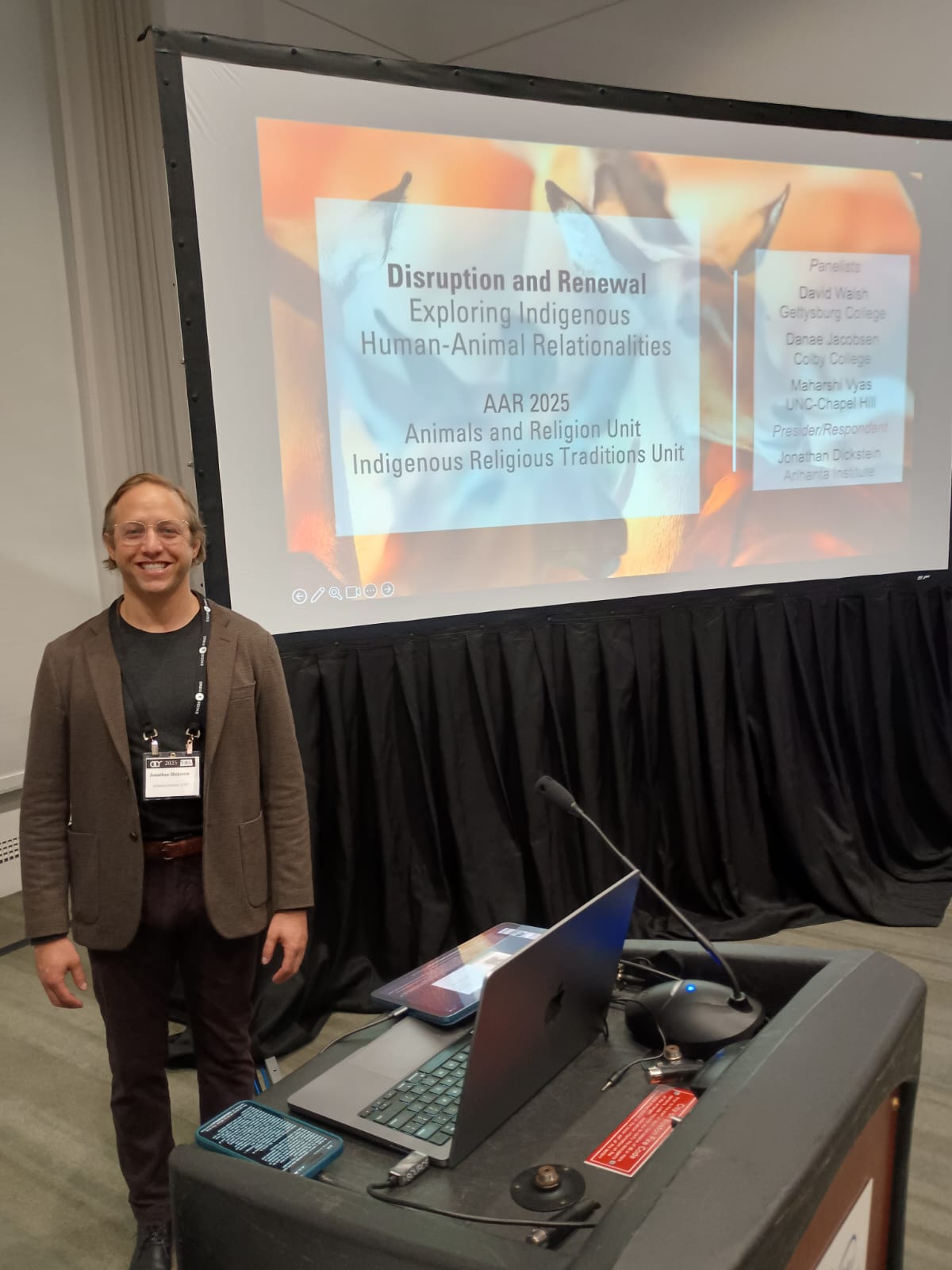
Jonathan Dickstein also kicked off the first AAR panel that I attended, in a co-sponsored session between the animals and religion unit and the indigenous religious traditions unit. As the respondent on the panel, he pointed out a number of important connections across the presentations, and in particular noted how the themes of intimacy and abstraction from animals were found in all of the papers. Interestingly, the words intimacy and self-sacrifice are often used today to describe the relationship between a (human) hunter and (non-human) hunted animal, while those who do not eat or kill animals (i.e., vegans and vegetarians) are often in an abstract, though non-violent, relationship to farmed animals globally, living in urban centers far from the routine violence of animal agriculture that they wish to avoid (as opposed to those in urban centers who routinely participate in this violence through consumption, though from a distance). We noted how discourses of “intimacy” and “self-sacrifice” potentially euphemize today’s unnecessary, routine, and very violent, slaughter of animals.
Next, we at the yoga in theory and practice unit co-sponsored two panels. The first was a panel on kuṇḍalinī co-sponsored with the tantric studies unit. Here, scholars presented different uses of kuṇḍalinī across tantric and yogic texts, archives, and cultures. Anya Foxen (Cal Poly San Luis Obispo/Harvard University), my former co-chair of the yoga in theory and practice unit, recently co-published an entire book on kuṇḍalinī, The Serpent’s Tale, demonstrating, as this panel also did, that the meaning and experience of kuṇḍalinī has never been static and has changed according to historical circumstances.
The second panel we co-sponsored was with the music and religion unit. This panel was organized by my colleague Brita Renée Heimarck (Boston University) as a review of her forthcoming volume Yogic Traditions and Sacred Sound Practices in the United States (SUNY 2026). As a scholar of modern yoga studies who also studies yoga music, I presented my chapter about a countercultural guru’s entanglements of her Sāṃkhya-yoga teachings with the instrumentation of the counterculture in Long Island, New York.
In addition to these two co-sponsored panels, we also had a standalone panel on the theme of “Authenticity” in yoga, where scholars demonstrated the anxieties around claiming one’s belonging to an authentic yoga tradition globally. As scholars recognize, and as this panel demonstrated, there is not one original or authentic yoga tradition, only a plurality of yoga traditions that make claims to authenticity in order to produce power and authority.
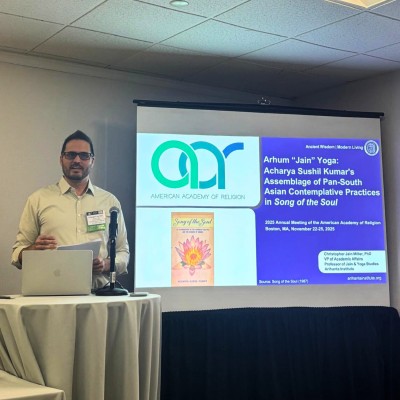
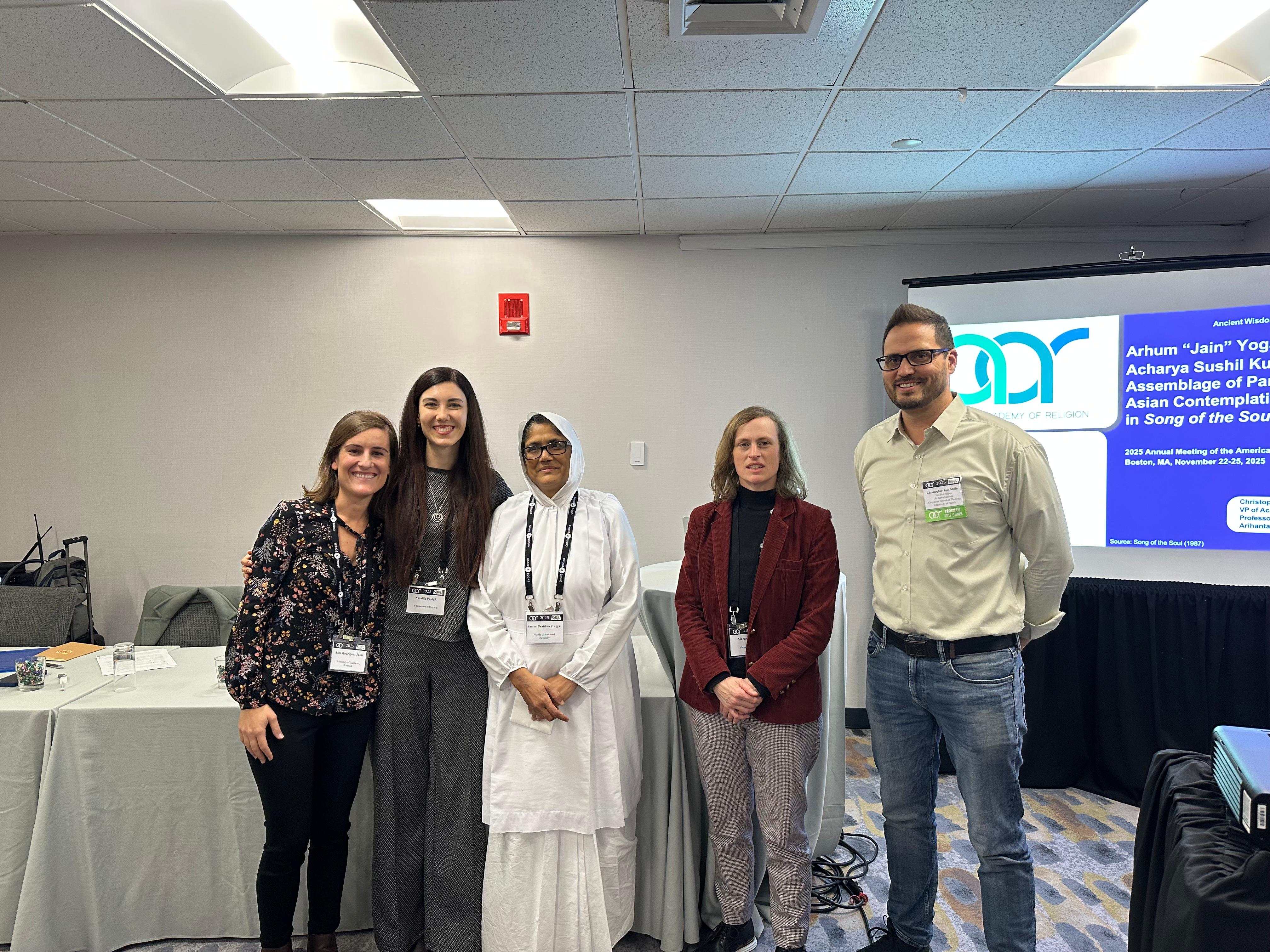
The contemplative studies unit also sponsored a panel on Jain Contemplative Practices organized by Alba Rodríguez Juan (UC Riverside). Particularly noteworthy here was her presentation on contemplative practices in Yaśovijaya’s work in comparison with Patañjali, and Morgan Curtis’s (Harvard) presentation on Jain Tamil literary narratives wherein contemplation on animals represents a central contemplative practice that eventually leads to ascetic renunciation. I was also able to present Acharya Sushil Kumar’s “Arhum Yoga” from his book Song of the Soul on this panel, with a special focus on his contemplative practice of listening for an unstruck sound (anāhata-nāda) within during meditation.
An extra bonus this year was Allyson Huval’s (Georgetown) paper titled "Christian Yoga, Christian Mysticism" co-sponsored by the Christian spirituality and Christian mysticism units. Huval provided new insights into Jean-Marie Déchanet's Christian Yoga.
Between these sessions at meetings, meals, and university receptions, the 2025 AAR in Boston was a great place to connect with so many colleagues and friends who we barely see in person, but often work with so closely across continents. We look forward to seeing you all at the 2026 AAR in Denver!
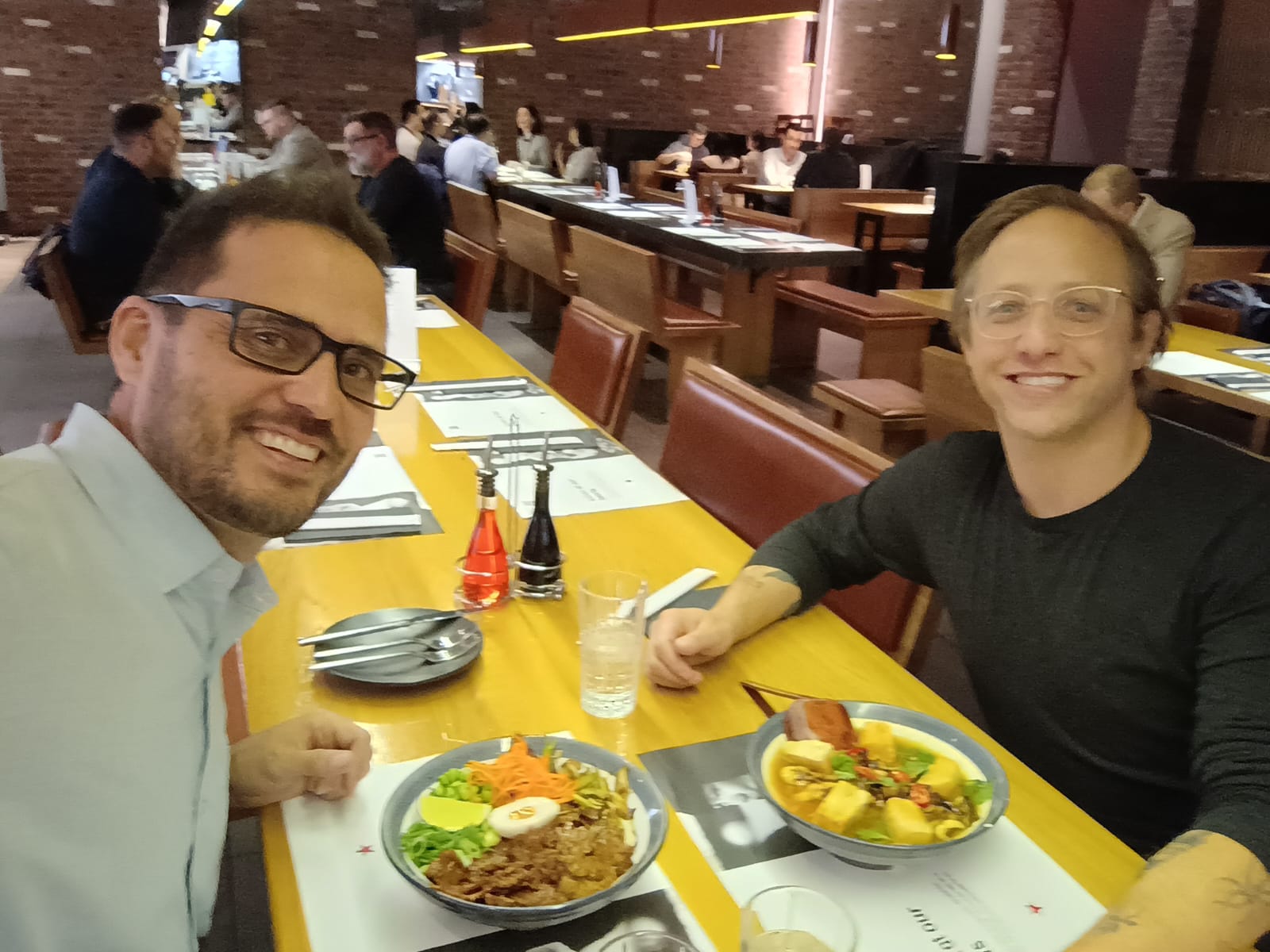
Dr. Miller and Dr. Dickstein enjoying a vegan lunch together.
Dr. Dickstein responds at the “Disruption and Renewal: Exploring Indigenous Human-Animal Relationalities” panel.
"Compassion as a Path to Freedom" panel at DANAM.
The Contemplative Studies Panel organized by Alba Rodriguez Juan on Jain Contemplative Practices.
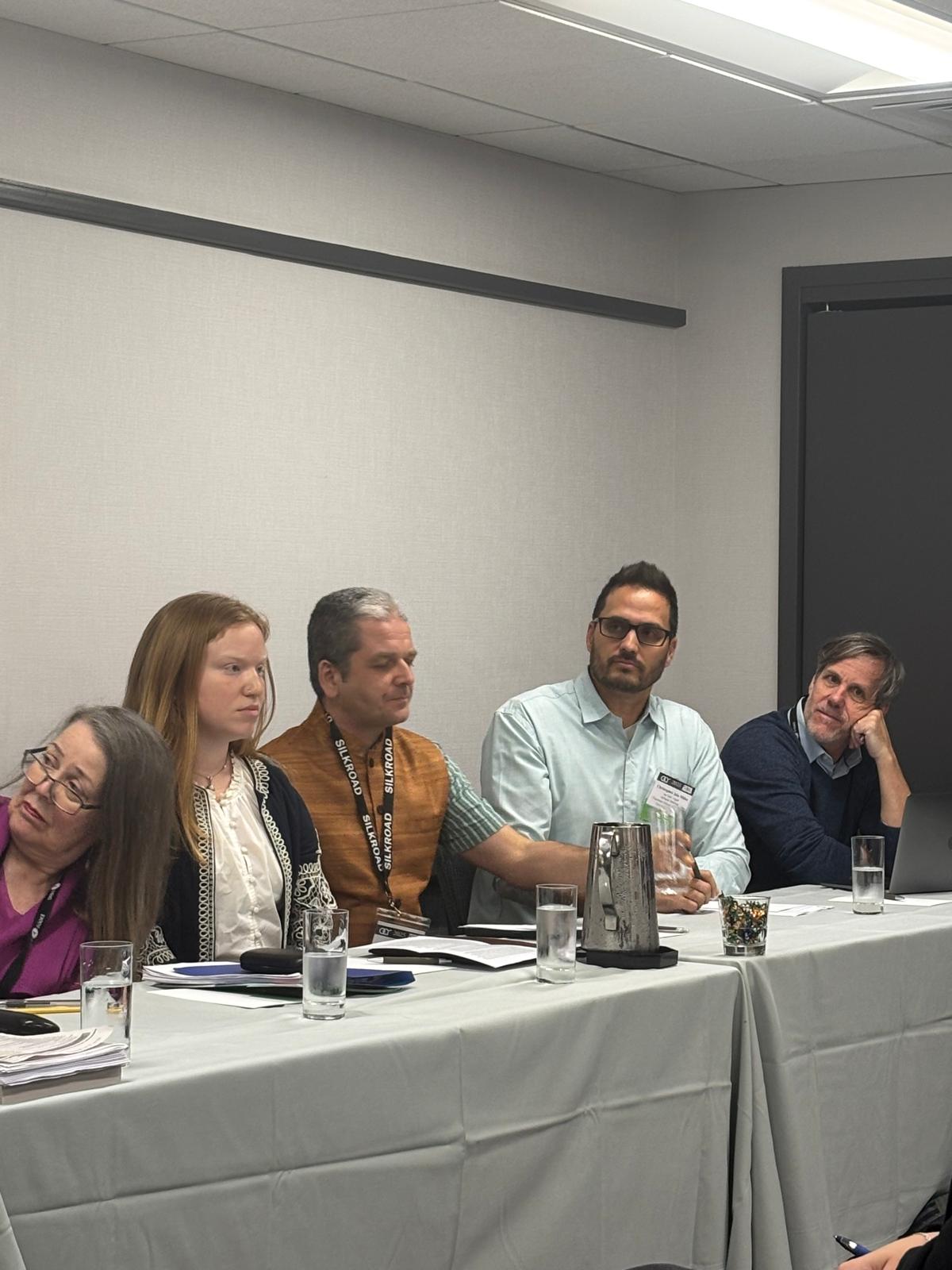
The yogic traditions and sacred sounds panel was organized by Brita Renee Heimark, editor of the volume to which the panelists contributed.
Christopher Jain Miller, is the co-founder, Vice President of Academic Affairs, and Professor of Jain and Yoga Studies at Arihanta Institute. He completed his PhD in the study of Religion at the University of California, Davis and is also a Visiting Researcher at the University of Zürich's Asien-Orient-Institut and Adjunct Professor at Claremont School of Theology where he co-developed and co-runs the fully-online MA-Engaged Jain Studies graduate program.