
Back To Blogs
Vegan Studies: Year in Review 2025
01/12/2026
It’s hard to believe that the Vegan Studies Initiative (VSI) at Arihanta began less than two years ago. What started as an experiment in bringing Vegan Studies into both Jain Studies and the public eye quickly grew into a vibrant platform for teaching, dialogue, and exploratory scholarship. The year 2025 marked VSI’s first full calendar year of programming, and it was a foundational one: four new online courses and eight podcast episodes. In 2025, VSI paused its popular Voices in Vegan Studies (ViVS) speaker series and launched the first season of Voices in Compassion Studies(ViCS). ViVS will return in February with nine events featuring scholars and practitioners working across anthropology, neuroscience, philosophy, grassroots organizing, and food science. Before we look ahead to an ambitious slate of programming in 2026, we reflect on what the VSI accomplished in 2025.
New Courses
Our self-paced online courses in 2025 showcased the breadth of contemporary Vegan Studies—from philosophy and ethics to pop culture, gender, and lived practice.
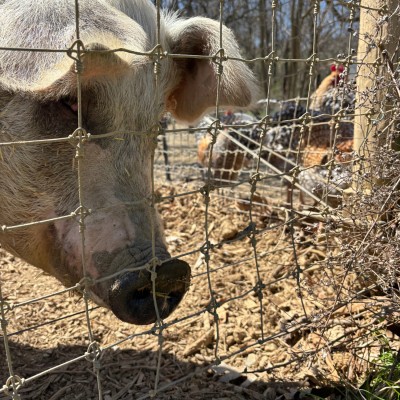
“Animal Sanctuary: Solutions in Nonviolence”, taught by Lancaster Farm Sanctuary co-founder Jonina Turzi, explored farm animal sanctuaries as both ethical practice and political intervention. Situating sanctuaries within a 10,000-year history of animal exploitation, the course examined how sanctuary movements—particularly over the past four decades—have offered tangible responses rooted in care, kinship, and nonviolence. Students engaged the history, philosophy, and everyday realities of sanctuary work, and were able to “meet” (that is, digitally) many of the nonhuman residents of Lancaster Farm Sanctuary.
In “Veganism & Pop Culture,” Christopher Sebastian turned our attention to the powerful role of media in shaping ethical sensibilities. Drawing inspiration from thinkers like bell hooks, the course treated popular culture as a primary site of moral education—often more influential than abstract theory. Through films, television, and literature—such as Wicked, King Kong, and The Sopranos—students examined fictional representations of animals and advocacy, learning how popular narratives have shaped modern attitudes toward veganism, compassion, and “otherness.”
“Foundations of Animal Ethics,” taught by Jishnu Guha-Majumdar, addressed a question many people intuitively feel but struggle to articulate: Why exactly is the way humans treat animals morally wrong? The course surveyed foundational ethical frameworks, from classical approaches to contemporary interventions, while juxtaposing theory with the dark realities of animal suffering today. Rather than treating ethics as an abstract exercise, the course emphasized how understanding moral justification is essential for shaping meaningful individual and collective action.
Finally, “Gender, Animals, and Veganism,” taught by Laura Wright (who coined the term “Vegan Studies”), brought a specific intersectional lens to Vegan Studies. Challenging the stereotype of veganism as white, elitist, and feminized, the course examined how gender shapes vegan identity and how veganism, in turn, renders women—particularly fictional female protagonists—vulnerable to misinterpretation and ostracization. Reading from fiction and nonfiction, students explored how Vegan Studies complicates questions of power, embodiment, and social status, providing key ways to understand the entanglements of human and animal oppression.
Podcast Conversations
VSI’s educational programming extended beyond the classroom through the Engaged Jain Studies Podcast (EJSP). Professor Jonathan Dickstein hosted each of the year’s instructors for in-depth conversations about their personal paths into Vegan Studies, their scholarly interests, and the motivations behind their teaching and advocacy. The year also included four special “live” video episodes, expanding the podcast’s scope and format with audience-interactive conversations with additional figures in the field.
In “Indian Cow Politics and Beyond,” Yamini Narayanan discussed her groundbreaking book Mother Cow, Mother India. The conversation examined dairy, nationalism, and multispecies politics in India, pushing listeners to grapple with the ethical complications and contradictions present in cow protection, dairy consumption, and various human–animal hierarchies in South Asia.
“Radical Jainism!?” brought together Anjli Shah, Sahana Mehta, and Mohit Mookim for a wide-ranging roundtable discussion on applying Jain principles to contemporary struggles around wealth inequality, gender justice, racial discrimination, and food systems. Centering the voices of “next-generation” Indian American Jains, the episode asked what Jain ethics can—and should—look like in 21st-century movements for social change.
In “People Power for Animal Freedom,” Jonathan spoke with Laila Kassam, Executive Director of UK-based Project Phoenix, about the past, present, and future of the animal liberation movement. Reflecting on decades of advocacy, the conversation explored missed opportunities, lessons learned, and the urgent need for new strategies to shift public opinion and build durable movements for animals.
To close out 2025, “Vegan Then and Now” featured acclaimed author and educator Victoria Moran, who reflected on more than five decades of compassionate living and teaching. From her years of experience with veganism’s countercultural roots to its mainstream visbility today, Moran traced how her veganism endures as both a lifelong ethical commitment and a spiritual path.
Year Three
As VSI moves into its third calendar year, Arihanta continues to invest in Vegan Studies—not a niche concern, but as a vital lens for understanding some of the most pressing ethical questions of our time. We are deeply grateful to our instructors, guests, students, and listeners for making this year so meaningful, and we look forward to continuing the work together in 2026. Stay tuned!
Jonathan Dickstein, Tirthankara Shreyansanath Endowed Assistant Professor of Jain and Vegan Studies at Arihanta Institute, completed his PhD in Religious Studies at the University of California-Santa Barbara. He specializes in South Asian Religions, Animals and Religion, and Comparative Ethics. His current work focuses on Jainism and contemporary ecological issues, extending into Critical Animal Studies, Food Studies, and Diaspora Studies.
Professor Dickstein is the lead organizer of the Vegan Studies Initiative at Arihanta Institute. arihantainstitute.org/vegan-studies
Additional articles by Professor Dickstein: