
Back To Blogs
Journey Through Engaged Jain Studies: An Interview with Chaitanya Prakash
03/30/2026
Arihanta Institute, in collaboration with Claremont School of Theology, marks an important academic milestone in the development of the Master of Arts in Engaged Jain Studies.
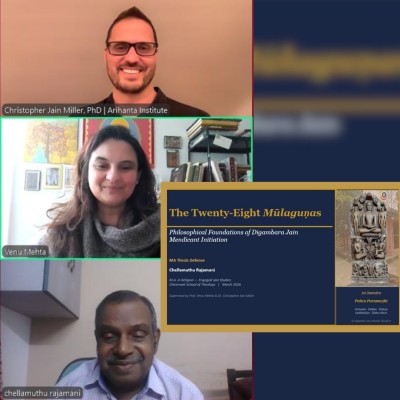
Chaitanya Prakash has successfully defended his MA thesis, “The Twenty-Eight Mūlaguṇas: Philosophical Foundations of Digambara Jain Mendicant Initiation.” Supervised by Dr. Venu Mehta and Dr. Christopher Jain Miller, his work offers a rigorous examination of the philosophical foundations of mendicant life, demonstrating how the mūlaguṇas function as an integrated system shaping ethical practice and spiritual transformation.
As the first student to complete the MA in Engaged Jain Studies, Chaitanya will graduate at the conclusion of the Spring 2026 semester—marking a significant moment for the program and its ongoing contribution to the field.
We extend our congratulations to Chaitanya on this achievement and invite you to read the following Q&A, where he reflects on his academic journey, research, and the broader implications of his work.
Chaitanya Prakash, MA in Religion, Engaged Jain Studies | Claremont School of Theology | Class of 2026
ORIGINS & MOTIVATION | What led you to pursue graduate study at this stage of your life? Why Jain Studies—and why an engaged approach?
Jainism captured my heart in childhood because of its emphasis on forgiveness, compassion, ahimsa (non-violence), and Karma theory. Much of our Tamil literature is rooted in Jainism; unfortunately, the tradition mostly disappeared from Tamil Nadu following the Bhakti movement. Even though I was born into a Hindu family, the desire to become a Jain saint never left me. This longing shaped my entire life.
My career took a different path. I spent over forty years in media leadership, but I also completed a Ph.D. in Education from Sardar Patel University and studied Communication Technology as a USA Fulbright Scholar at Syracuse University. While these achievements brought professional satisfaction—and my work with the non-profit Kids Care Rehab Centre providing free treatment to children with autism brought me peace—my spiritual hunger remained.
My search extended to other traditions: I practiced Vipassana meditation in Malaysia, became a novice Buddhist monk, and explored a comparative study of Islam and Saiva Siddhanta regarding the concepts of God and the soul. Each tradition touched my heart, but Jainism always remained at my core.
I had read about Jainism on my own and visited temples across India to seek blessings from Acharyasree Virag Sagar, Acharyasree Vishuddha Sagar, and Acharyasree Svithi Sagar. I read the works of Acharya Uma Swami and Acharya Kunda Kunda, but something was missing. Because I am from Tamil Nadu and did not know other Indian languages besides my mother tongue, Tamil, I needed to study these texts in English for a better understanding. Most resources were only available in Hindi, Sanskrit, and Prakrit. I needed teachers who could show me the depth I sensed but could not reach alone.
Then, I discovered Arihanta Institute and Claremont School of Theology online. While browsing, I read about how Dr. Christopher Jain Miller was moved by Jainism; that really motivated me to write to him. To my surprise, he replied, and I joined. Dr. Miller personally believed in me, and his warmth, along with the motivation from Dr. Parveen Jain, gave me the courage to begin. I came with an open heart, believing that ancient wisdom must speak to today's world. My story shows that transformation knows no age limit; the thirst for knowledge only grows deeper.
ENTERING THE PROGRAM | What surprised you most? What felt most challenging?
What surprised me most was how much my heart opened. I came with curiosity, but I left each class with wonder. The faculty did not just teach information; they transmitted wisdom and opened doors I did not know existed.
Under the guidance of Dr. Parveen Jain, Dr. Christopher Jain Miller, Dr. Venu Mehta, Dr. Cogen Bohanec, and Dr. Jonathan Dickstein, my understanding of Jain philosophy deepened in ways I never imagined. They taught me with such patience. Dr. Miller taught me the Tattvartha Sutra, focusing on the foundational verse: “Samyag-darshana-jnana-charitrani moksha-margah”—correct worldview, correct knowledge, and correct conduct comprise the path to liberation.
Through his teaching, the seven tattvas (realities) became alive in my heart: The Self (jiva), Not-Self (ajiva), the inflow of karma (asrava), the binding of karma (bandha), the stopping of karma (samvara), the wearing away of karma (nirjara), and liberation (moksha).
INTELLECTUAL DEVELOPMENT | Which ideas or texts most reshaped your thinking? How did faculty mentorship shape your scholarly voice?
Every faculty member touched my heart in a unique way. Dr. Venu Mehta, who supervised my thesis, taught me to read texts with patience and care, helping me listen to what the texts actually say. Her guidance shaped my scholarly voice—one that respects tradition while asking sincere questions.
Dr. Cogen Bohanec taught me Sanskrit with remarkable patience, opening the door to reading classical texts in their original language. I want to continue deepening my Sanskrit knowledge through the comprehensive courses Arihanta Institute offers. Dr. Jonathan Dickstein introduced me to Vegan Studies, showing how ahimsa extends to all living beings. This teaching expanded my heart; Dr. Jonathan even motivated me to visit slaughterhouses to educate others on compassion.
Dr. Kuan taught me comparative religion, showing how cultural dynamics influence practices like forgiveness and compassion in both Jainism and Christianity. Professor Frank Rogers and Professor Andrew Dreitcer gave me wisdom I treasure; their teaching on self-compassion as the foundation for compassion toward others transformed my daily practice. Learning alongside my classmates enriched my journey; we became a true community of seekers.
RESEARCH & CAPSTONE | What question anchored your thesis? Why does this research matter now?
My thesis is titled “The Twenty-Eight Mūlaguṇas: Philosophical Foundations of Digambara Jain Mendicant Initiation.” It explores the foundational qualities required for Digambara Jain monastic life. My central question came from my heart: What do these ancient requirements tell us about living a truly ethical life?
This question emerged from my personal journey of visiting Digambara saints and considering joining the Sangh. Dr. Venu Mehta taught me to examine these experiences with scholarly rigor, understanding the mulagunas as practices of samvara (stopping the inflow) and nirjara (shedding karma).
Beyond my thesis, I presented research at a symposium titled “Exploring Forgiveness Through Jain and Christian Prayer and Liturgical Practices.” I discovered that Jain forgiveness (kshama) is embedded in a karma-based framework, while Christian forgiveness operates within a theistic one. Despite these differences, both traditions use liturgical practices to embody forgiveness as a transformative spiritual practice. This research awakened a deeper longing to pursue doctoral studies to explore how religious leaders can foster interfaith dialogue and promote peace.
ENGAGEMENT & PRACTICE | How did the MA-EJS program help you connect theory with lived ethics? Were there tensions between tradition and contemporary application?
Yes, there were tensions, and I learned that this is healthy. Applying traditional teachings today requires thoughtful adaptation. Through the program, I learned to use the Tattvartha Sutra’s first verse as my guide.
Arihanta Institute bridges ancient wisdom with modern life through courses on climate change, animal welfare, and professional ethics. This aligns beautifully with anekantavada—the principle of many-sidedness. Truth is complex, and no single perspective captures the whole. My heart is drawn to these applications; I want to explore Yoga Studies and Compassion Studies further.
REFLECTION & TRANSFORMATION | How has your understanding of Jain values evolved? What will stay with you long after graduation?
My heart has been transformed. The principles of non-violence, multiple perspectives, and non-possession are now truths I feel. The seven tattvas provide my daily map, and the four passions—anger, pride, deceit, and greed—have become tools for self-examination.
My research on forgiveness deepened my appreciation for kshama, teaching me that universal reconciliation is both humbling and liberating. Anekantavada has made me a more patient listener and a more humble seeker.
What will stay with me? The Three Jewels, the discipline of svadhyaya (self-study), and the threefold rhythm of compassion. Graduation is not an ending; it is a beginning. I am hungry for more.
LOOKING FORWARD | What comes next? What would you say to someone considering this program?
I aspire to pursue doctoral studies in Jain Studies; this is my heart’s deepest desire. With forty years of media experience, I envision sharing Jain teachings with global audiences through contemporary platforms. I plan to organize workshops and interfaith dialogues to bring traditions together through compassion.
To someone considering this program: Come with openness and love. This program will transform you. You will find a community and mentors who genuinely care. Arihanta Institute offers extraordinary resources—over fifty courses covering everything from animal advocacy to social justice and yoga.
My story shows that transformation knows no age limit. I came with degrees and decades of experience, yet I came as a student ready to learn. If you want to understand Jainism as a living path to liberation, this is the place.
CLOSING THOUGHT
This journey has been one of the great gifts of my life. I came with a longing heart and found teachers who nurtured it. I am deeply grateful to Arihanta Institute, Claremont School of Theology, and my esteemed professors: Dr. Christopher Jain Miller, Dr. Parveen Jain, Dr. Venu Mehta, Dr. Cogen Bohanec, Dr. Jonathan Dickstein, Dr. Kuan, Professor Andrew Dreitcer, Professor Yuki Schwartz, Professor Vicki Wiltse, and Professor Frank Rogers.
"Jain education transforms lives. It brings peace, purpose, and the power to create positive change. I came as a seeker; I leave as a student who wants to learn forever."
The graduation of the first MA in Engaged Jain Studies student reflects what becomes possible when rigorous scholarship is both pursued and supported. The MA in Engaged Jain Studies continues to prepare students to engage deeply with Jain philosophical traditions while applying them to contemporary ethical and social challenges. If you are seeking a graduate program that combines academic rigor with meaningful application, we invite you to study with us. If you are committed to advancing Jain education and expanding access to this work globally, we invite you to donate now and support the next generation of scholars and practitioners.