

Back To Blogs
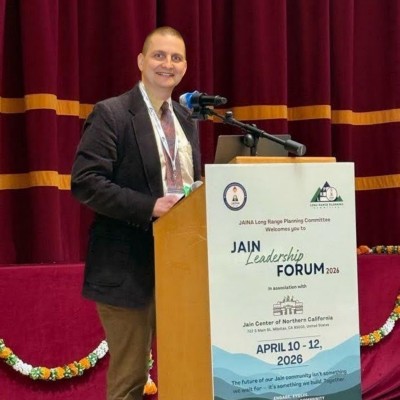
Jain Leadership Forum 2026
A Reflection
05/01/2026
Over the weekend of April 10 to 12, 2026, I had the honor and privilege of speaking at the Jain Leadership Forum at the Jain Center of Northern California in Milpitas, California. I was grateful to be invited as one of the four keynote speakers for this important gathering, which brought together Jain leaders, scholars, organizers, and community members from across North America for a sustained conversation about the future of Jain community life.
The Jain Leadership Forum was designed as a forward-looking, collaborative event focused on the vitality of Jain communities in North America. Its aim was not simply to celebrate existing institutions, but to think seriously and constructively about how Jain Centers can continue to serve as places of belonging, learning, service, ethical formation, and intergenerational connection. The organizers framed the event around questions that many communities are already asking in one form or another: How do we deepen engagement? How do we strengthen belonging across generations? How do we help Jain principles remain vibrant and compelling in modern life? Throughout the weekend, participants reflected on the changing needs of families, youth, young professionals, elders, and community leaders, and explored practical as well as philosophical ways of supporting a more connected and purposeful Jain future.
What impressed me most about the Forum was its seriousness of purpose. This was not simply a ceremonial event or a series of disconnected presentations. It was a genuine leadership gathering, one that sought to combine reflection, data, strategy, and vision. The program included sessions on community engagement, the psychology of belonging, intergenerational dialogue, leadership development, and the long-range future of Jain institutions in North America. It was clear throughout that the organizers were trying to create a space in which participants could think honestly about present challenges while also imagining larger possibilities for the future. There was a real desire to move beyond maintenance and toward renewal.
My own keynote was titled From Survival to Significance: Reclaiming Jain Identity, Value, and Purpose in a Modern World. In that talk, I tried to address one part of the broader conversation by asking why so many values that resonate strongly within Jainism, such as nonviolence, mindfulness, restraint, ethical responsibility, and care for living beings, have become increasingly visible in contemporary culture, while Jainism itself is not always experienced by younger generations or the wider public as a primary source of meaning, identity, and intellectual guidance. In other words, why do Jain values remain deeply relevant, while Jainism can sometimes appear optional, cultural, or contained?
My argument was that this is not fundamentally a problem of relevance. Jainism does not lack relevance. Rather, the deeper issue is that modernity has reshaped how many people understand value itself. In much modern thought, facts are treated as objective and binding, while values are often treated as subjective, negotiable, or merely matters of preference. This has created a world in which people may admire ethics, speak positively about compassion, and affirm nonviolence in principle, while still struggling to experience these commitments as grounded, necessary, or compelling. Ethical ideals survive, but they often lose some of their binding force.
From that starting point, I suggested that Jain philosophy offers a powerful alternative. Jain thought does not treat ethics as something we simply project onto an otherwise neutral world. It understands value as built into the structure of reality itself. Karma, in this framework, is not merely a metaphor for moral consequence, but a real account of how actions shape the self and its condition. Nonviolence, restraint, and responsibility are therefore not simply admirable ideals. They are intelligible responses to the way reality is structured. That gives Jain ethics a depth and coherence that many contemporary ethical movements are still searching for.
I also spoke about the way Jain insights often reappear in modern culture in partial or fragmented form. Mindfulness, veganism, and yoga, for example, each express important ethical or contemplative intuitions, but they are frequently disconnected from the larger philosophical frameworks that once gave them coherence, discipline, and moral depth. My point was not to dismiss these movements, but to suggest that they reveal an ongoing need. People are still searching for clarity, discipline, responsibility, and meaningful ethical life. Jainism already speaks to these concerns with remarkable sophistication, but it is not always recognized as a knowledge tradition capable of addressing them in a full and integrated way.
From there, I turned to what I described as a decolonial diagnosis of the problem. Too often, traditions such as Jainism are received as heritage, identity, or culture, but not as serious truth-bearing accounts of reality. Modern secular and scientific forms of knowledge are commonly treated as universal and authoritative, while dharmic traditions are subtly relegated to the realm of the personal, symbolic, or communal. Over time, communities can internalize that hierarchy themselves. The result is a kind of epistemic insecurity in which Jain values may still be respected, but Jain philosophy is not always presented with confidence as a coherent and intellectually defensible vision of the world.
For that reason, one of the central points of my talk was that the future vitality of Jain communities will depend not only on programming or institutional strategy, but on clarity and confidence. If Jainism is presented primarily as inherited culture, it may be honored but not deeply inhabited. If it is articulated as a serious account of reality, value, selfhood, and transformation, it becomes something much more compelling. In that sense, I argued that the shift Jain communities are being called to make is not merely from low engagement to high engagement, but from survival to significance. Survival asks how we preserve what we have received. Significance asks how we understand it deeply enough to live it fully and contribute from it meaningfully in the present world.
That theme seemed especially fitting for the Forum as a whole. The weekend was full of thoughtful conversation about how Jain communities can remain rooted in tradition while responding creatively and intelligently to the needs of contemporary life. It was clear that the organizers and participants alike care deeply about the future, not only of Jain institutions, but of Jain vision. There was a desire to think beyond maintenance, beyond attendance, and beyond surface-level participation, and to ask what it would really mean for Jain Centers to become vibrant spaces of formation, belonging, service, and shared purpose.
I left the Forum grateful for the invitation, encouraged by the depth of the conversations, and hopeful about what this gathering represented. It was a privilege to contribute one voice among many over the course of the weekend. The Jain Leadership Forum made clear that there are thoughtful and committed leaders across North America who are willing to ask difficult questions, reflect with honesty, and work collaboratively toward a more meaningful and generative future. That is no small thing. In a time when many communities are struggling to sustain belonging and clarity, this kind of serious collective reflection matters. I was honored to be part of this inspiring collaboration.
Cogen Bohanec, MA, PhD holds the position of Assistant Professor in Sanskrit and Jain Studies at Arihanta Institute where he teaches various courses on Jain philosophy and its applications. He received his doctorate in Historical and Cultural Studies of Religion from the Graduate Theological Union (GTU) in Berkeley, California where his research emphasized comparative dharmic traditions and the philosophy of religion. He teaches several foundational self-paced, online courses based in Jain philosophy, yoga, ecology, languages, and interfaith peace-building, including: