✔️ Added course to cart

View Cart
Schedule
Learning Area
Instructor
Course Type

14-DAY FREE TRIAL

Subscribe to Arihanta Institute’s Course Membership for unlimited access to our growing library of live and self-paced courses.

Start Your Free Trial

Self-paced

1000 | Foundations of Jain Studies

Open-Access
Learn More
Added to cart

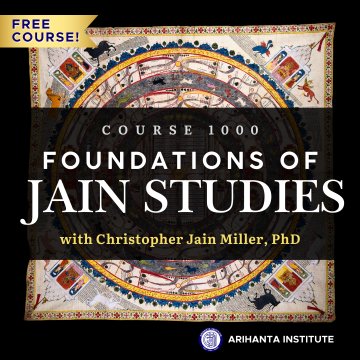
1000 | Foundations of Jain Studies

This course offers an introduction to Jain Studies. Begin with an exploration of key Jain teachings and practices, focusing on the principles of non-harming (ahiṃsā) and non-possession (aparigraha), both central to the tradition. Delve, then, into the Three Jewels of Jainism—right worldview, right knowledge, and right conduct—and examine how these principles shape the foundation of the Jain tradition. Next, investigate the profound connection between Jainism and animal advocacy, exploring the teachings of Mahavira on animals as well as contemporary Jain practices of animal care. Afterwards, explore the Jain perspective on the human body, including the importance of health, the role of karmas in shaping one’s embodiment, and the fine line between bodily renunciation and the need to have good health. Finally, observe how Jainism’s commitment to compassion and social justice is expressed through transformative social initiatives, focusing on the work of Acharya Chandanaji and the global reach of her charitable organization, Veerayatan.  Learning Objectives:Understand the core principles of Jainism, including the practices of non-harming (ahiṃsā) and non-possession (aparigraha).Analyze the Three Jewels of Jainism (right worldview, right knowledge, and right conduct).Evaluate the relationship between Jainism and animal advocacy.Learn the Jain perspective on the human body and its role in spiritual practice.Assess the role of compassion and social justice in Jainism.
Open-Access

Instructor

Self-paced
Self-paced

3004 | Modern Yoga Studies: Critical History, Anthropology and Methodology

$99.00 USD
Learn More
Added to cart

3004 | Modern Yoga Studies: Critical History, Anthropology and Methodology

One of the primary questions students of modern yoga seek to answer is precisely how the forms of contemporary yoga practiced today are connected to pre-modern forms of yoga developed in India. To begin to answer this question and to formulate new questions, this course will trace some of the historical continuities and discontinuities between pre-modern and modern yoga practices, demonstrating that modern yoga is a complicated, transnational cultural product. We will explore the legacy of the first yoga teachers who brought yoga to America and Europe as well as yoga’s development from a historical, social, and political perspective.Students will thus take into account current scholarly debates regarding the relationship of transnational yoga to categories such as capitalism, neoliberalism, orientalism, racism, speciesism, gender, cultural appropriation, biopolitics, nationalism, and colonization. Doing so will encourage yoga practitioners to adopt new methodologies concerning the critical study of modern yoga, and will also give them an opportunity to confront and unravel saṃskāras, or acquired mental impressions and social conditionings, related to their inherited beliefs regarding the origins, history, and contemporary practice of yoga. The course is thus simultaneously intellectual as well as, from a yogic perspective, transformational.
$99.00 USD

Instructor

Self-paced

3005 | Modern Yoga, Embodied Self-Care and Healing

$99.00 USD
Learn More
Added to cart

3005 | Modern Yoga, Embodied Self-Care and Healing

This course builds on the understanding of modern yoga as a set of historically evolved body-mind practices and discourses that developed into an effective, late-modern self-care. Based on this definition, contemporary yoga – inspired by both pre-modern practices, such as āsana and prāṇāyāma as well as more modern practices, such as mindfulness, body awareness or relaxation techniques – can be defined as a highly efficient tool for self-care. It continues to evolve by adapting to contemporary needs and contributes to the health of late modern societies.In 1946, the World Health Organization defined “health” as complete physical, mental, and social wellbeing. Thus, cultural studies can and have to contribute to such a holistic understanding of health with their view on humans as biological, but likewise social, ritual, symbolic and deeply interconnected beings, very much so via their bodies.But how can this insight be brought into practice? The course examines theories on embodiment and body knowledge and enriches our existing, individual yoga practice with additional, accessible, and highly efficient tools for self-care. It helps developing a more elaborate and sophisticated language as well as a deepened understanding for embodied processes. This includes the knowledge and training of our external and internal senses, getting to know our individual body image and understanding that how we talk to ourselves matters. We investigate the body scheme, understand the importance of touch, flow-states, relaxation, and other techniques that we can employ for both, getting to know but also to transcend ourselves as well as to understand ourselves as fully interconnected beings. Knowing one’s own body in such elaborate ways can, in a yogic manner, help to unlearn embodied habits and conditioning and to gain distance from them whenever needed.
$99.00 USD

Instructor

Self-paced

3007 | Ancient and Classical Jain Yoga

$99.00 USD
Learn More
Added to cart

3007 | Ancient and Classical Jain Yoga

This course provides an in-depth exploration of yoga and meditation as understood within ancient and classical Jain scriptures. In Part 1: Ancient Jain Yoga, students will be introduced to foundational concepts such as āsana, or physical postures, as a tool for purification and meditation. Drawing from early Jain texts, including the Uttarādhyayanasūtra and the Daśavaikālikasūtra, students will learn how restraint of the body, mind, and speech formed early Jain definitions of yoga.  Part 2: Yoga and Meditation in Classical Jain Philosophy, transitions into an examination of the Tattvārthsūtra and its commentaries, where yoga is described as the inflow (āsrava) of karma—representing an obstacle to spiritual liberation. Students will explore the key to liberation through correct worldview, knowledge, and conduct, as well as the role of dhyāna (meditation) as both an austerity (tapas) and a means of wearing away (nirjarā) karma. Through a discussion of virtuous (dharma) and pure (śukla) meditation, the course will highlight how advanced meditation practices lead to spiritual purification and the elimination of karma, providing a comprehensive understanding of Jain yoga's ultimate aim of mokṣa, or liberation. This is designed as a two-week course that will take approximately 4 hours to complete, and includes readings and a series of 10 lectures to guide you through the intricacies of ancient and classical Jain definitions of Yoga. Learning Objectives:Learn the role of āsana (physical postures) in ancient Jain yoga as a tool for purification and meditation.Discover how restraint of body, mind, and speech formed early Jain definitions of yoga, with guidance from key ancient texts.Explore the classical Jain philosophical view of yoga as the inflow (āsrava) of karma, and see how this concept is discussed in the Tattvārthsūtra and its commentaries.Understand how meditation (dhyāna) serves as an austerity (tapas) to wear away karma (nirjarā) and how virtuous (dharma) and pure (śukla) meditation practices lead to spiritual purification and liberation (mokṣa).
$99.00 USD

Instructor

Self-paced

3008 | Yogabindu & Yogadṛṣṭisamuccaya: The Yogas of Haribhadrasūri

$99.00 USD
Learn More
Added to cart

3008 | Yogabindu & Yogadṛṣṭisamuccaya: The Yogas of Haribhadrasūri

This course offers a close exploration of the teachings and historical contexts of two significant teachers of early Śvetāmbara Jain yoga: Haribhadra Virahāṇka and Haribhadra Yākinīputra.Beginning with an introduction to Haribhadra Virahāṇka’s (ca. 6 th c. CE) hagiography, we will examine how his legendary name reflects the Jain path to liberation (mokṣa), setting the stage for a study of his yoga texts aimed for the same goal: the Yogabindu and Yogaśataka. In addition to looking at the limited historical evidence regarding Haribhadra Virahāṇka’s tentative 6 th c. CE dating, the course will analyze Haribhadra’s categorization of yoga practitioners into three levels, with a focus on the cāritrin (pathgoer), who embodies the path of comprehensive Jain yoga practice. Through a detailed examination of the five types of yoga in the Yogabindu, students will understand how these practices facilitate liberation according to Jain karma theory. Students will also appreciate how the Yogabindu represents Jainism’s first-known exposition of “yoga” as a spiritual path, rather than something that causes the inflow of karma as understood in the preceding classical period.Transitioning to Haribhadra Yākinīputra (ca. 8 th c. CE), the course will delve into his hagiography as well as his distinct contributions to Jain yoga, the Yogadṛṣṭisamuccaya and Yogaviṁśikā. We will investigate how Haribhadra Yākinīputra is historically (and tentatively) dated to the 8 th c. CE, while also appreciating how he both integrates but also simultanesouly critiques various traditions such as tantra, Buddhism, and Brahmanism within his Jain framework. Finally, students will understand how Haribhadra maps his yoga philosophy onto not only Patañjali’s 8-limbed yoga but also Jain concepts including the 14 guṇasthānas.  Students will appreciate how the two Haribhadras put their respective Jain teachings into dialogue with other religious and philosophical traditions, while maintaining a commitment to their own Jain tradition.This is designed as a two-week course that will take approximately 4 hours to complete, and includes readings and a series of 10 lectures to guide you through the intricacies of the yogas of Haribhadra Virahāṇka and Haribhadra Yākinīputra.  It is recommended, though not required, that students complete course 3007 “Ancient and Classical Jain Yoga” before taking this course if they wish to have further background on Jain yoga.  Learning Objectives:1. Learn the histories and hagiographies of Haribhadra Virahāṇka and Haribhadra Yākinīputra to understand how their legendary names were created.2. Understand Haribhadra Virahāṇka’s categorization of yoga practitioners, focusing on the cāritrin and the five types of yoga practices in the Yogabindu, to grasp their role in facilitating liberation through Jain karma theory.3. Learn the contributions of Haribhadra Yākinīputra to Jain yoga, especially hisYogadṛṣṭisamuccaya, and how he critiques and integrates various traditions such as tantra, Buddhism, and Brahmanism within his yoga framework.
$99.00 USD

Instructor

Self-paced

3009 | Samayasāra and Jñānārṇava: The Yogas of Kundakunda and Śubhacandra

$99.00 USD
Learn More
Added to cart

3009 | Samayasāra and Jñānārṇava: The Yogas of Kundakunda and Śubhacandra

This course explores Jain understandings of yoga according to two pivotal Digambar Jain authors, looking at Kundakunda's Samayasāra and Śubhacandra's Jñānārṇava. We begin with Kundakunda's inquiry into the nature of the soul in Samayasāra, examining how his insights contrast with earlier Jain interpretations and broader South Asian philosophical frameworks. Lectures are focused on explicating Kundakunda's understanding of karma, the soul, and his celebrated higher (niścaya) and lower (vyavahāra) viewpoints (naya). The course highlights Kundakunda's critiques of his contemporaneous philosophical systems, providing students with the tools to appreciate his contributions to Jain yoga and South Asian philosophy more broadly.   Transitioning to Śubhacandra's Jñānārṇava, students will explore how the text reflects both Jain principles and practices as well as elements from Patanjali’s 8-fold yoga and even tantric traditions. Students will thereby observe how Jñānārṇava maintains a commitment to the ontological, soteriological, and ethical dimensions of Jainism while incorporating practices such as meditation, posture, and breath control shared by other yoga systems.By the end of the course, students will understand how both texts dialogue with historical traditions and provide rich pathways toward spiritual growth and liberation within the framework of Jain yoga.This is designed as a two-week course that will take approximately 4 hours to complete, and includes readings and a series of 10 lectures to guide you through important dimensions of Samayasāra and Jñānārṇava.It is recommended, though not required, that students complete courses 3007 “Ancient and Classical Jain Yoga” and 3008 “Yogabindu and Yogadṛṣṭisamuccaya: The Yogas of Haribhadrasūri” before taking this course if they wish to have further background on Jain yoga.  Learning Objectives:• Understand Kundakunda's unique interpretations of the soul, karma, and thematerial world in Samayasāra and how they contrast with other Jain and SouthAsian philosophical perspectives• Explore Śubhacandra's Jñānārṇava, identifying how it incorporates elements of Patanjali’s 8-fold yoga and tantra while remaining rooted in Jain ontological and ethical principles• Gain an appreciation for two uniquely Digambara contributions to thedevelopment of Jain yoga
$99.00 USD

Instructor

Self-paced
Self-paced
Graduate Course

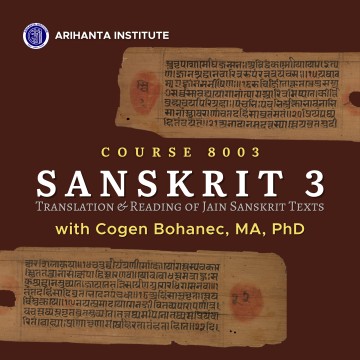
8003 | University Sanskrit 3: Translation & Reading of Jain Sanskrit Texts

This course is designed for students who have completed an introductory first-yearcourse in Sanskrit and who are familiarized with the content of the Devavāṇīpraveśikā or an equivalent primer. Students will engage in the reading and translation of an important source from the Jain canon, along with its commentary. This course aims to deepen students' understanding of Sanskrit language and literature, as well as introduce them to the commentarial style and tradition. We may select specific texts that are relevant to students’ research and thus help students with their research in terms of translating primary sources. Learning Objectives • Develop advanced Sanskrit reading and translation skills.• Analyze and interpret complex Sanskrit texts.• Understand the commentarial style and tradition in Sanskrit literature with aparticular focus on the Jain tradition, but also in conversation with Hindu andBuddhist traditions.• Apply knowledge of Sanskrit grammar and syntax to translation.• Discuss nuances of South Asian philosophy, theology, languages, literature,culture, etc.• Assist and advise students regarding their research in terms of employment oftranslations of primary source texts.
Coming Fall 2026. This seminar meets: Tuesdays and Fridays (September & October) 5:00 – 6:30 p.m. Pacific and Tuesdays and Fridays (November & December) 6:00 – 7:30 p.m. Pacific
$500.00 USD

Instructor
Graduate Course

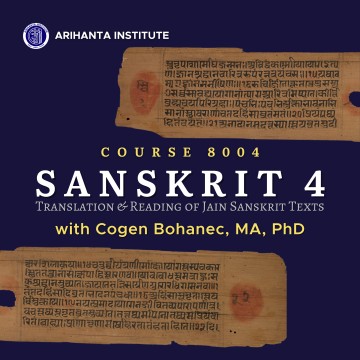
8004 | Sanskrit 4: Translation & Reading of Jain Sanskrit Texts

$600.00 USD
Learn More
Added to cart

8004 | Sanskrit 4: Translation & Reading of Jain Sanskrit Texts

This advanced Sanskrit course is a direct continuation of Sanskrit 3 and forms part of Arihanta Institute’s ongoing faculty–student research project on Hemacandra’s Yoga-śāstra and its Svopajña-vivaraṇa commentary. Designed for students who have completed a foundational first-year Sanskrit sequence and can read intermediate prose and verse texts, the course applies grammatical and interpretive knowledge to the translation and analysis of this seminal Jain treatise. Through the close reading of Yoga-śāstra passages and their commentarial explanations, students deepen their understanding of Sanskrit syntax, Jain philosophical vocabulary, and classical scholastic style while situating the text within broader South Asian intellectual traditions. In addition to its focus on Jain philosophy and hermeneutics, the course provides a linguistic foundation for understanding the evolution of Indo-Aryan languages. Mastery of Sanskrit at this level equips students for further study of the Middle Indo-Aryan Prakrits, Apabhraṃśas, and later vernaculars—languages that are central to the study of Jain and wider South Asian literary traditions. Emphasis is placed on developing publication-quality translation and research skills, integrating philological precision, hermeneutic awareness, and critical engagement with primary and secondary sources. By participating in a collaborative academic environment—where faculty and students contribute to an evolving body of Jain Studies scholarship—students refine their ability to produce rigorous, well-annotated translations suitable for conference presentation or publication. The course culminates in an independent research paper demonstrating mastery of Sanskrit language and commentarial analysis within the context of Hemacandra’s thought and Jain philosophy more broadly. This course is not offered directly for university credit from Arihanta Institute. However, students who wish to receive language credit from their home institutions (including the MA in Engaged Jain Studies at Claremont School of Theology) are encouraged to contact their administrations to explore the possibility of having this course count toward academic credit through their home institutions. Many universities, particularly at the graduate level, provide mechanisms such as a “special reading course,” “directed reading course,” or other forms of independent study that allow students to work with a faculty member at their institution to tailor a course to their specific needs. In the past, Arihanta Institute students have successfully arranged with their home institutions to take our language classes for university credits from their home institutions under such frameworks, with our instructors providing the final grade and grading rubric directly to their institution. If you are interested in pursuing academic credit in this way, please consult with your home institution’s administration about the available options, and Dr. Bohanec will be happy to work with them to submit your grade for the course to them. Learning ObjectivesDevelop advanced Sanskrit reading, translation, and philological skills, demonstrating mastery of complex grammar, syntax, and vocabulary through accurate and idiomatic renderings of primary texts.Analyze and interpret Sanskrit commentarial literature with attention to Jain philosophical frameworks—particularly Hemacandra’s Yoga-śāstra and Svopajña-vivaraṇa—while engaging in comparative hermeneutic dialogue with Hindu and Buddhist traditions.Apply linguistic and hermeneutic methods to assess philosophical arguments, religious language, and the structure of commentarial reasoning in premodern South Asian texts.Situate Jain philosophical texts within broader South Asian and global intellectual traditions, including comparative study of dharmic and Abrahamic perspectives on ethics, epistemology, and contemplative practice.Discuss and critique nuances in South Asian philosophy, theology, linguistics, literature, and culture, demonstrating both technical precision and interpretive depth.Produce publication-quality translation and research projects, integrating philological analysis, hermeneutic reflection, and ethical awareness appropriate to graduate-level scholarship.
Spring 2026 (January 26 – May 4, 2026)
Tuesday 8:00 - 9:30 a.m. PT and Friday 8:00 - 9:30 a.m. PT
$600.00 USD

Instructor

Enrollment Options

ENROLLMENT TUITION

  • $99 one time payment
  • Lifetime access to course
    #### | Name.
Enroll

14-DAY FREE TRIAL

  • Free, unlimited access to our self-paced courses for 14-days.
  • Already used your free trial? Enroll in our Monthly or Annual Membership options at anytime and continue learning immediately!
Start Your Free Trial

MONTHLY MEMBERSHIP

  • $45 USD / Month
  • Immediate access to course
    #### | Name.
  • Unlimited access to our live and self-paced courses for one month, with month-to-month auto rollover.
  • Excludes graduate seminars, language courses, and courses hosted on partner platforms.
Enroll In Membership
Yes
No

Subscribe to
Our Newsletter