

Back To Blogs
_27866_orig)
_29215_orig)
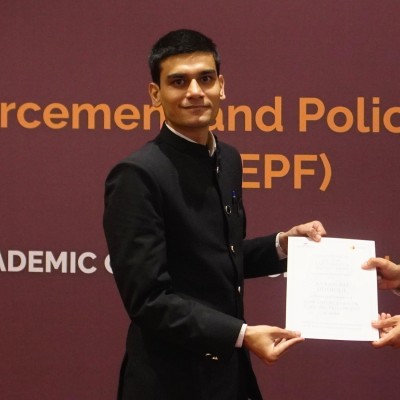
Ayaan Ali Siddiqui presented at a national conference under the theme “Policy Pathways for Future-Ready Policing.”
When Harm Signals Harm:
Animal Cruelty, Social Deviance, and Engaged Scholarship in Action
03/03/2026
MA–Engaged Jain Studies student Ayaan Ali Siddiqui advances policy reform through studying Jain ethics
Violence rarely appears without warning. Long before it manifests in large-scale social harm, it often surfaces in smaller, overlooked acts—acts that institutions may dismiss as peripheral or insignificant. One such act is cruelty toward animals.
Ayaan Ali Siddiqui, a student in the Master of Arts in Engaged Jain Studies offered by Claremont School of Theology in collaboration with Arihanta Institute, is advancing a rigorous and data-driven argument: crimes against animals are statistically significant predictors of broader patterns of social deviance.
From Fellowship Research to National Policy Discourse
Ayaan’s paper emerged from a year-long empirical policy research project conducted through the Law Enforcement and Policing Fellowship, jointly supported by the Indian Police Foundation and the Takshashila Institution. Presented at a national conference under the theme “Policy Pathways for Future-Ready Policing,” the study sought to move beyond anecdote.
While Western scholarship has long examined the correlation between animal cruelty and subsequent interpersonal violence, the Indian context has lacked domestic empirical data. Discussions have often relied on imported frameworks or narrative accounts. Ayaan’s research directly addressed this gap by producing original Indian data to test the relationship statistically.
The findings were clear: animal cruelty should not be treated as a trivial or isolated offense. Instead, it functions as an early indicator within broader patterns of antisocial and deviant behavior. For policymakers and law enforcement agencies, this reframes how such crimes should be recorded, analyzed, and addressed within predictive and preventive policing frameworks.
Engaged Jain Studies as Theoretical Foundation
This research was not merely technical. It was also philosophical.
Ayaan’s work is closely integrated with his MA studies, particularly Jain ethical philosophy and its foundational commitment to ahiṃsā (nonviolence). Jain thought does not treat harm to animals as morally peripheral; rather, it situates violence toward any living being within a continuum of ethical degradation.
By placing empirical data in dialogue with Jain ethics, Ayaan’s research bridges two domains often kept separate: normative philosophy and public policy. His earlier academic training in psychology further strengthened the study’s analytical framework, allowing him to approach the issue from both behavioral and ethical perspectives.
This interdisciplinary integration reflects the distinctive structure of the MA in Engaged Jain Studies: a graduate program designed to bring classical ethical traditions into substantive engagement with contemporary social institutions, including law, governance, ecology, and public systems.
Scholarly Review and Ongoing Impact
The completed capstone was reviewed by Professor Christopher Jain Miller and Professor Venu Mehta, whose feedback helped refine its methodological and theoretical precision. The work was also presented at the Engaged Jain Studies Graduate Student Colloquium under the title:
“Concomitance Between Crimes Against Animals and Social Deviance.”
(The colloquium replay is now available here.)
(The colloquium replay is now available here.)
Following further revision incorporating conference feedback, the paper has been submitted to the Indian Police Journal (published by BPR&D under India’s Ministry of Home Affairs) for consideration in its Urban Policing issue.
If accepted, the publication will extend the study’s impact from academic discourse into national policy conversations—precisely the kind of trajectory Engaged Jain Studies aims to foster.
Rethinking What We Call “Minor” Offenses
At stake in this research is more than a statistical correlation. It is a conceptual shift.
When institutions dismiss certain forms of violence as minor, they risk overlooking systemic warning signs. By demonstrating that crimes against animals are empirically linked to broader deviance, Ayaan’s work calls for reclassification—not only in policing databases, but in ethical consciousness.
The research Ayaan conducted exemplifies engaged scholarship: philosophically grounded, empirically rigorous, and institutionally relevant.
Study with Purpose
The Master of Arts in Engaged Jain Studies—offered fully online by Claremont School of Theology in collaboration with Arihanta Institute—is currently accepting applications for Fall 2026 admission through June 1, 2026. Scholarships are available.
For students seeking to integrate ethical philosophy, empirical research, and real-world institutional reform, this program provides a uniquely rigorous platform. If you are interested in applying or just want to learn more, please visit the MA-EJS graduate studies webpage or email study@arihantainstitute.org for more information.
Because engaged learning is not simply about understanding the world—it is about transforming it.
📸: Provided by Ayaan Ali Siddiqui.