About CSAL
About CSAL
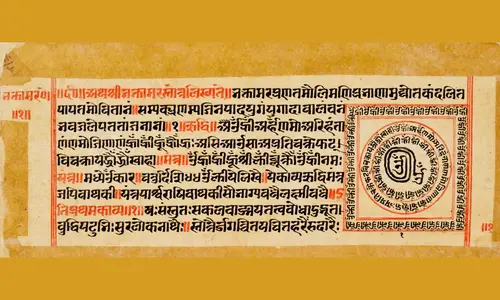
[Above] Leaf from a Bhaktāmara Stotra manuscript. British Library, MS Or. 13741; Public-domain artwork; photo licensed CC BY 4.0.
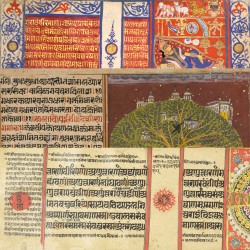
[Header] Kalpa Sūtra, manuscript leaf, attributed to Bhadrabāhu, India, 15th century. Collection of the Metropolitan Museum of Art, Open Access (public domain).
The Center for South Asian Languages (CSAL) is a teaching and research center dedicated to the rigorous instruction, scholarly research, and responsible preservation of South Asian languages and cultures within the academic mission of Arihanta Institute, an IRC 501(c)(3) nonprofit organization.
CSAL supports language learning, textual study, and research
grounded in ethical scholarship and accessible pedagogy,
enabling students, scholars, and practitioners to engage directly
with South Asia’s linguistic and literary traditions.
Subscribe To Newsletter
CSAL will launch beginning in the 2026 academic year, with an initial launch phase spanning 2026
– 27. Any future additions — such as expanded programming, staffing, or research initiatives
— would be considered separately and only if additional funding and institutional
resources become available.
Course Rotation Plan
| Year |
Fall Semester |
Spring Semester |
| Every year |
Sanskrit 1 (Beginning) &
Sanskrit 3 (Advanced)
|
Sanskrit 2 (Intermediate) &
Sanskrit 4 (Advanced II)
|
| Alternate years (2025–26) |
Gujarati 1 (Beginning) |
Gujarati 2 (Intermediate) |
|
Alternate years (2027–28)*
|
Ardhamāgadhī 1 (Beginning) |
Ardhamāgadhī 2 (Intermediate) |
*For the school year 2026-2027 Dr. Bohanec will be in India researching, so only the Sanskrit courses will be offered
Public Naming and Communications Guidance
Beginning in the 2026 academic year, the name Center for South Asian Languages (CSAL) may
be used publicly in Arihanta Institute communications to identify and describe the
coordination of existing South Asian language instruction and related academic activities. During this initial
launch phase (2026–27), CSAL should be presented as an organizing and branding framework
that brings together current and formally planned language offerings under a single academic
center.
At this stage, public language should remain descriptive and clarificatory in nature,
emphasizing visibility rather than expansion or growth. Appropriate descriptions include
references to CSAL as a teaching and research center that names and organizes existing courses
and projects already supported within Arihanta Institute’s current infrastructure.
Public communications should not announce or imply the creation of new programs,
courses, faculty or staff positions, budgetary expansions, or new research initiatives.
Any future developments beyond the scope of coordination and branding would be considered separately
and only if additional institutional resources and funding become available.
Illustrative Example: Research - Framed Language Instruction
Within the CSAL framework, language instruction may be presented along a pedagogical
continuum reflecting different stages of scholarly development. Introductory and intermediate
first - year courses emphasize foundational teaching and learning objectives, including
grammatical competence, reading fluency, and linguistic confidence necessary for sustained
engagement with primary texts. At more advanced, second-year levels, instruction may
increasingly foreground research-oriented practices, such as collaborative translation, close
textual analysis, engagement with appropriate scholarly methods, and publication
as a potential outcome.
At the advanced level, CSAL may frame language instruction as a collaborative research
activity undertaken jointly by faculty and students under the auspices of the Center.
For example,advanced Sanskrit instruction (Sanskrit 3) at Arihanta Institute has been organized around the
collaborative translation and close study of Hemacandra’s Yogaśāstra and its auto-commentary(Svopajña-vivaraṇa).
Within a CSAL framework, this course may be presented as a faculty-led
research project in which students participate as developing scholars, applying advanced
linguistic skills to translation, textual analysis, and interpretation of canonical Jain philosophic
alworks, with publication as a potential outcome of this work.Where publications or public-facing
scholarly outputs emerge, they may be highlighted through CSAL’s existing communication channels—such as the CSAL
webpage or institutional social media—as examples of research integrated into language instruction, without constituting a separate research program or
marketing initiative. This framing reflects and brands an existing program and does not introduce new initiatives at this initial stage.
As advanced Gujarati and Ardhamāgadhī instruction is developed, similar approaches may be applied in the future



 Cogen Bohanec, MA, PhD
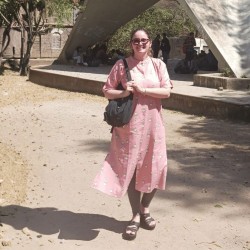
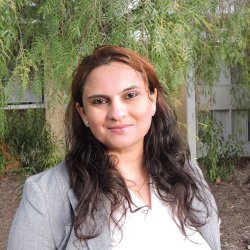 Venu Mehta
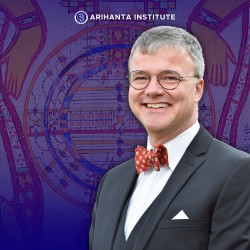
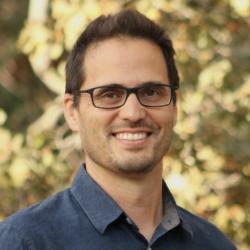 Christopher Miller, PhD











 (7)_orig_54111_orig)