
Back To Blogs
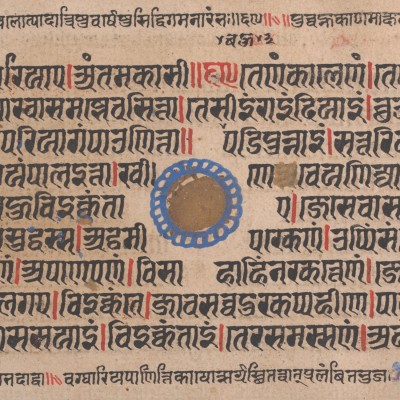
Leaf from a Kalpa Sutra (Jain Book of Rituals). Bhadrabahu, Gujarat, India. 15th century.
Arihanta Institute Launches the Center for South Asian Languages
Research, Preservation, and Rigorous Language Training for Jain and South Asian Studies
05/26/2026
Launching the Center for South Asian Languages
Arihanta Institute is pleased to announce the launch of the Center for South Asian Languages (CSAL), a new initiative dedicated to rigorous language instruction, textual study, and the preservation of Jain and South Asian linguistic heritage.
CSAL brings together Arihanta Institute’s growing language programs in Sanskrit, Gujarati, and Ardhamāgadhī within a unified academic framework. The Center supports students, scholars, practitioners, and independent learners who seek meaningful engagement with South Asian religious, philosophical, literary, and cultural traditions through direct study of their languages.
At a time when many universities are reducing or eliminating South Asian language offerings, CSAL seeks to help address a growing gap within the humanities and Religious Studies. Serious scholarship in Jain, Buddhist, Hindu, and broader South Asian Studies depends upon sustained engagement with primary sources, living linguistic traditions, and the careful study of both classical and modern South Asian languages. Through accessible online instruction, CSAL makes this training available to students around the world.
Language study is not merely a technical skill; it is a means of entering the intellectual, ethical, philosophical, and contemplative worlds preserved within South Asian textual traditions. Through CSAL, Arihanta Institute seeks to support students in engaging primary sources carefully, responsibly, and with deeper awareness of the traditions and communities from which they emerge.
By integrating rigorous philological training with sustained textual engagement, CSAL aims to cultivate a new generation of scholars capable of working across languages, traditions, and historical periods with both intellectual precision and cultural humility.
By integrating rigorous philological training with sustained textual engagement, CSAL aims to cultivate a new generation of scholars capable of working across languages, traditions, and historical periods with both intellectual precision and cultural humility.
Core Language Offerings
CSAL’s academic foundation rests on a sequence of live online language courses designed to support both beginning and advanced study. We offer a full Sanskrit sequence, including beginning, intermediate, and advanced courses. These courses prepare students for sustained translation work in Sanskrit religious, philosophical, and literary texts, with particular relevance for Jain, Hindu, and Buddhist Studies.
CSAL’s academic foundation rests on a sequence of live online language courses designed to support both beginning and advanced study. We offer a full Sanskrit sequence, including beginning, intermediate, and advanced courses. These courses prepare students for sustained translation work in Sanskrit religious, philosophical, and literary texts, with particular relevance for Jain, Hindu, and Buddhist Studies.
Moreover, our Gujarati instruction supports students seeking access to modern South Asian literature, community discourse, devotional materials, and contemporary cultural contexts within Jain, Hindu, and related South Asian traditions. The Gujarati sequence is especially valuable for students working with Gujarati-speaking communities in India or the diaspora, engaging modern textual traditions, or studying vernacular religious life. It also provides preparation for the study of Middle and Early Gujarati literatures.
Our forthcoming Ardhamāgadhī Prākṛt offerings will provide students with training in one of the most important canonical languages of the Jain tradition. These courses will support direct engagement with Śvetāmbara Jain canonical literature and related Prākṛt materials. Unlike many Prākṛt courses, which focus primarily on historical linguistics or grammatical survey, CSAL’s Ardhamāgadhī sequence is designed explicitly as a research language program. The goal is to equip students to begin reading and translating Ardhamāgadhī texts directly for their own scholarly work following completion of the two-semester sequence.
Together, these offerings create a pathway from introductory language study to advanced textual engagement, addressing a growing concern within South Asian and Religious Studies regarding the decline of rigorous language training. CSAL is founded on the conviction that meaningful scholarship in Jain, Hindu, Buddhist, and broader South Asian traditions depends upon sustained engagement with primary sources, living linguistic traditions, and the ability to work responsibly across both classical and modern South Asian languages.
Our forthcoming Ardhamāgadhī Prākṛt offerings will provide students with training in one of the most important canonical languages of the Jain tradition. These courses will support direct engagement with Śvetāmbara Jain canonical literature and related Prākṛt materials. Unlike many Prākṛt courses, which focus primarily on historical linguistics or grammatical survey, CSAL’s Ardhamāgadhī sequence is designed explicitly as a research language program. The goal is to equip students to begin reading and translating Ardhamāgadhī texts directly for their own scholarly work following completion of the two-semester sequence.
Together, these offerings create a pathway from introductory language study to advanced textual engagement, addressing a growing concern within South Asian and Religious Studies regarding the decline of rigorous language training. CSAL is founded on the conviction that meaningful scholarship in Jain, Hindu, Buddhist, and broader South Asian traditions depends upon sustained engagement with primary sources, living linguistic traditions, and the ability to work responsibly across both classical and modern South Asian languages.
Course Structure
CSAL offers two primary pathways for developing rigorous South Asian language training. The first is a traditional four-semester sequence in which students develop progressive competency in their chosen language. During the first semester (Beginning) and second semester (Intermediate), students build a strong grammatical foundation through sustained study of morphology, syntax, vocabulary, reading, and translation. These courses are ordinarily offered in the fall and spring semesters respectively. Upon completion of the foundational sequence, students may continue into the third (Advanced I) and fourth (Advanced II) semesters, where instruction shifts toward sustained textual engagement, guided translation, philological analysis, and research-oriented reading practices.
Unlike many university language sequences that conclude after introductory grammatical coverage, CSAL’s advanced courses are designed as ongoing spaces for serious textual study. Students may continue participating in advanced reading courses beyond the four-semester sequence in order to deepen their engagement with specific literary, philosophical, religious, or historical traditions. In this way, CSAL seeks not merely to introduce languages, but to cultivate long-term scholarly competency rooted in direct engagement with primary sources.
Beyond foundational instruction, CSAL’s advanced language sequences are designed to support long-term scholarly development and collaborative research between students and faculty. Advanced students engage directly with selected primary texts through guided translation, close reading, and philological analysis, often in conversation with their own developing research interests. In this way, the classroom becomes not only a site of instruction, but also a collaborative scholarly community centered on sustained textual engagement.
CSAL also offers University Sanskrit 1 & 2 Summer Intensive, an eight-week synchronous online program that integrates the equivalent of the first two semesters of Sanskrit into a single accelerated summer format. Students work through the full Devavāṇīpraveśikā Sanskrit primer with emphasis on Devanāgarī reading, grammatical analysis, paradigm recitation, memorization, and guided translation. The intensive is especially well suited for graduate students preparing for research in South Asian religions, philosophy, literature, or history, as well as highly motivated independent learners seeking immersive language training.
An International and Collaborative Learning Community
CSAL is designed to serve a wide range of learners, including graduate and undergraduate students, independent scholars, practitioners, and qualified members of the broader public. Its online format allows students from many regions of the world to access rigorous, academic language instruction without relocating or enrolling in a traditional residential program. At the same time, this global format creates unusually diverse classrooms in which students from different countries, religious traditions, academic disciplines, and cultural backgrounds learn together in sustained dialogue. These international learning environments enrich classroom discussion and help students situate South Asian texts and traditions within broader global and intercultural conversations.
The Center also supports Arihanta Institute’s broader mission of engaged, ethically grounded, and academically serious Jain and South Asian Studies. At a time when funding and institutional support for rigorous language training are increasingly difficult to sustain within higher education, CSAL seeks to preserve not only the linguistic and textual heritage of South Asian traditions, but also the broader scholarly culture of careful philological study, responsible interpretation, and meaningful engagement with primary sources. The program is founded on the conviction that languages are not merely technical tools, but living carriers of intellectual, philosophical, literary, and religious worlds that deserve careful preservation and continued study.
CSAL’s flexible online structure also allows students to integrate language study into existing graduate programs and research trajectories. Although Arihanta Institute does not presently function as an independently accredited degree-granting institution, faculty regularly coordinate with students and their home universities to support independent-study credit, directed readings, transfer arrangements, language competency examinations, and other forms of academic integration where possible. This flexibility allows students from institutions that may not offer South Asian language instruction to pursue rigorous training while remaining enrolled in their existing academic programs.
Arihanta Institute invites students, scholars, practitioners, and all serious learners to explore the Center for South Asian Languages. Whether one is preparing for graduate research, deepening engagement with Jain traditions, or beginning a lifelong study of South Asian languages, CSAL offers a rigorous, collaborative, and internationally accessible pathway into the linguistic worlds that sustain these traditions.
The Center also supports Arihanta Institute’s broader mission of engaged, ethically grounded, and academically serious Jain and South Asian Studies. At a time when funding and institutional support for rigorous language training are increasingly difficult to sustain within higher education, CSAL seeks to preserve not only the linguistic and textual heritage of South Asian traditions, but also the broader scholarly culture of careful philological study, responsible interpretation, and meaningful engagement with primary sources. The program is founded on the conviction that languages are not merely technical tools, but living carriers of intellectual, philosophical, literary, and religious worlds that deserve careful preservation and continued study.
CSAL’s flexible online structure also allows students to integrate language study into existing graduate programs and research trajectories. Although Arihanta Institute does not presently function as an independently accredited degree-granting institution, faculty regularly coordinate with students and their home universities to support independent-study credit, directed readings, transfer arrangements, language competency examinations, and other forms of academic integration where possible. This flexibility allows students from institutions that may not offer South Asian language instruction to pursue rigorous training while remaining enrolled in their existing academic programs.
Arihanta Institute invites students, scholars, practitioners, and all serious learners to explore the Center for South Asian Languages. Whether one is preparing for graduate research, deepening engagement with Jain traditions, or beginning a lifelong study of South Asian languages, CSAL offers a rigorous, collaborative, and internationally accessible pathway into the linguistic worlds that sustain these traditions.
For more information about CSAL and upcoming language courses, please visit the Center for South Asian Languages page, here: arihantainstitute.org/language-studies.