

Back To Blogs
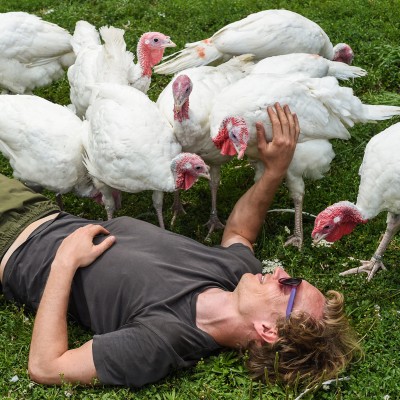
Activist Jan Sorgenfrei communes with rescued turkeys at Farm Sanctuary's New York shelter. Farm Sanctuary, Watkins Glen, New York, USA, 2015. Jo-Anne McArthur / We Animals
Spiritual Veganism and Ahiṃsā Living
06/04/2026
Spiritual Veganism and Ahiṃsā Living
I have been vegan for almost thirty years, and during this time veganism has remained a central—if not the central—feature of my spiritual identity. This conviction was strengthened early in my life with my wife, Hope Bohanec, who is an internationally recognized vegan advocate, independent scholar, activist, and educator.
Nearly twenty-five years ago, when Hope and I were first courting, I was deeply involved in multiple spiritual communities and religious traditions—both through my academic research and through personal participation. Hope, by contrast, did not identify with any particular religious or spiritual tradition. And yet she said something to me that has resonated across the decades: “Veganism is my religion.”
“Veganism is my religion”
In the twenty-five years since then, I have pursued advanced degrees in religion and philosophy, including a Ph.D. in Hindu Studies and an M.A. in Buddhist Studies from the Graduate Theological Union in Berkeley. Much of my scholarship in my near thirty publications has centered on animal ethics and environmental ethics in South Asian traditions. To list only a few, for example, in “Jain Virtue Ethics Engaging with Animal Rights,” I examined how Jain moral frameworks speak directly to contemporary animal rights discourse. In “Jain Biophilia: Philosophy in Action,” I explored how Jain reverence for life (jīva-dayā) provides a foundation for ecological and animal-centered ethics. And in “Jain Ecotheology Engaging with Ecopsychology,” I brought Jain categories of nonviolence into conversation with modern ecological psychology.
In the twenty-five years since then, I have pursued advanced degrees in religion and philosophy, including a Ph.D. in Hindu Studies and an M.A. in Buddhist Studies from the Graduate Theological Union in Berkeley. Much of my scholarship in my near thirty publications has centered on animal ethics and environmental ethics in South Asian traditions. To list only a few, for example, in “Jain Virtue Ethics Engaging with Animal Rights,” I examined how Jain moral frameworks speak directly to contemporary animal rights discourse. In “Jain Biophilia: Philosophy in Action,” I explored how Jain reverence for life (jīva-dayā) provides a foundation for ecological and animal-centered ethics. And in “Jain Ecotheology Engaging with Ecopsychology,” I brought Jain categories of nonviolence into conversation with modern ecological psychology.
Alongside these works, I have also written on the role of animals in Gauḍīya Vaiṣṇavism—such as “Śrī Caitanya’s Implicit and Explicit Regard for Animals”—and on the connections between ahiṃsā, food, and ecology in Hindu literature, including “Ahiṃsā, Animals, and Vegetarianism in Hindu Literature.” Across nearly thirty publications, I return again and again to a simple truth: a spiritual life grounded in compassion for animals is inseparable from ecological responsibility. It is through this lens that I continue to reflect on my wife’s words, realizing that veganism is not simply a dietary choice or an ethical stance—it is at the very center of my spiritual identity.
The Pluralism of Veganism
Of course, I am not suggesting that this is the only way to understand veganism. Veganism is a pluralistic tradition, and the meanings people attach to it are as diverse as those who practice it. For some, veganism is primarily an ethical orientation, unrelated to any sense of spirituality. For others, it may be an environmental strategy, a form of boycott aimed at the industries that exploit animals and degrade ecosystems. Still others see veganism as a philosophical system, a lifestyle, a cultural marker, or simply as a pragmatic health choice.
Of course, I am not suggesting that this is the only way to understand veganism. Veganism is a pluralistic tradition, and the meanings people attach to it are as diverse as those who practice it. For some, veganism is primarily an ethical orientation, unrelated to any sense of spirituality. For others, it may be an environmental strategy, a form of boycott aimed at the industries that exploit animals and degrade ecosystems. Still others see veganism as a philosophical system, a lifestyle, a cultural marker, or simply as a pragmatic health choice.
No single approach is more correct, defensible, or complete than another. By its very nature, veganism resists gatekeepers who attempt to universalize its meaning beyond the basic abstention from animal products, especially in food production. This pluralism is a strength, for it allows individuals and communities to embody veganism in ways that resonate most deeply with their values and circumstances.
And yet, for me and for many others, veganism is explicitly spiritual. This dimension became increasingly evident as I navigated a wide range of religious communities. Time and again, I found that my ability to participate fully with these communities was limited by the centrality of animal consumption in congregational settings. I often felt more spiritually at home among vegan atheists—who may have rejected nearly all of my metaphysical beliefs—than among members of my own religious tradition who were not vegan.
Over the years, as I spoke with countless spiritual vegans, I discovered that this was not unique. Many people find stronger bonds with fellow vegans across religious traditions—Hindus, Jains, Buddhists, Christians, Muslims, Jews, atheists—than with non-vegan members of their own nominal communities. For us, veganism is not an accessory to our religious identity; it is a central component. It is the common thread that weaves together our diverse beliefs and practices into a shared spiritual orientation across religious and non-religious spiritual traditions.
This is why Hope and I launched the Ahiṃsā Living Circle in 2025 in collaboration with Arihanta Institute: to create a space where the spiritual dimensions of veganism could be explored, nurtured, and honored.
Defining Veganism: Minimal or Meaningful?
This raises an important question: how should veganism be defined? Is it simply the practice of avoiding animal-derived products, or does the term carry ethical, spiritual, or philosophical weight that extends beyond dietary choices?
One common approach is to define veganism minimally and descriptively—as abstention from animal products. This definition is clear and accessible. It allows for a wide range of motivations and avoids imposing a particular ideology on all practitioners. By lowering the barriers to entry, it may even broaden participation in the movement.
But is that really how veganism functions in the lives of those who call themselves vegan? For many, the answer is no. Saying “I am vegan” is not just a factual statement about diet. It is an identity claim. Like saying “I am a pacifist” or “I practice ahiṃsā,” it signals belonging to a moral or spiritual tradition. It expresses values, commitments, and a sense of orientation in the world. In these cases, defining veganism without reference to meaning or motive is incomplete, even alienating.
Veganism as a Lived Identity
Definitions do not exist in a vacuum; they are shaped by communities of practice. Veganism, like religion, is a lived identity. It is not subject to external verification or falsification in the same way as a scientific hypothesis. When someone says they are vegan because of their spiritual beliefs or ethical convictions, that meaning becomes part of what veganism is—for them and for the communities that share their understanding. Their understanding and the validity of their identities cannot be falsified through empirical verification or philosophical analyses.
This does not mean veganism must always imply a particular philosophy. But it does mean that for many people, it already does. For them, the ethical and spiritual meanings attached to veganism are not distractions from its “real” content; they are intrinsic to it.
A minimalist definition—veganism as nothing more than abstention—may obscure this reality. A person who avoids meat as a form of spiritual discipline is not merely behaving in a certain way; they are bearing witness to a truth they believe. Their veganism is inseparable from the reasons they live it.
The Problem of Gatekeeping
Some argue that acknowledging these deeper meanings creates gatekeeping—that it risks excluding those whose motivations are more pragmatic or less ideologically defined. But the opposite may be true. To insist that veganism must be defined only in behavioral terms—stripped of ethical, philosophical, or spiritual meaning—erases the lived experiences of the majority of vegans who do attach such meanings.
Some argue that acknowledging these deeper meanings creates gatekeeping—that it risks excluding those whose motivations are more pragmatic or less ideologically defined. But the opposite may be true. To insist that veganism must be defined only in behavioral terms—stripped of ethical, philosophical, or spiritual meaning—erases the lived experiences of the majority of vegans who do attach such meanings.
If someone abstains from animal products as an expression of ahiṃsā, or out of solidarity with oppressed beings, or as a spiritual vow, who has the authority to declare that these motivations are not central to their veganism? To say “veganism is only about diet” is not neutrality; it is reductionism. It diminishes the fullness of what people actually live.
Veganism is more than what one avoids—it is what one affirms. And what one affirms—justice, compassion, nonviolence, kinship, spiritual discipline—is not an ornament to the practice but its heart.
Historical Roots of Spiritual Veganism
The contemporary articulation of veganism as a spiritual path may seem new, but its roots stretch deep into South Asian traditions that have shaped my own academic research and teaching.
In Jainism, the principle of ahiṃsā has guided dietary practices for millennia. Jain monks and nuns adopt rigorous vows of nonviolence, extending care to the smallest forms of life. While traditional Jain vegetarianism often permitted dairy, contemporary Jain reform movements increasingly interpret ahiṃsā as requiring full veganism.
In Hinduism, the concept of ahiṃsā paramo dharmaḥ (“nonviolence is the highest dharma”) has long inspired practices of vegetarianism. In bhakti traditions I have studied, such as Gauḍīya Vaiṣṇavism, food offered to God (prasāda) is expected to be nonviolent, affirming the sacredness of life. For many contemporary Gauḍīya Vaiṣṇavas, this too implies veganism.
In Buddhism, the first precept—abstaining from taking life—has motivated both monastic and lay communities to adopt plant-based diets, with debates stretching across centuries about how far this discipline should extend. Notably, Chinese Mahāyāna Buddhists developed some of the world’s oldest continuous vegetarian cultures, who mostly also minimized or rejected dairy products (which were often culturally not consumed in China), making them strikingly close to what we now call veganism. For these communities, abstention from animal products was not merely dietary but was understood as a central expression of their faith and commitment to compassion.
These traditions reveal that the spiritual dimension of food ethics is not a modern innovation. Rather, it is an ongoing conversation, one that veganism now carries forward in the global context. In my own scholarship—whether in Jain ecotheology, Vaiṣṇava virtue ethics, or contemplative studies of Buddhist and Hindu texts—I have consistently seen how food choices are tied to the deepest questions of compassion, justice, and liberation.
In this light, spiritual veganism is not a break from tradition but its continuation, adapted to the realities of our age: industrial agriculture, climate crisis, and the scale of animal suffering unimaginable in earlier centuries.
Veganism, Spirituality, and Ahiṃsā
For those of us who approach veganism spiritually, the concept of ahiṃsā—nonviolence—is central. Rooted in Jain, Hindu, and Buddhist traditions, ahiṃsā is more than an ethic of avoiding harm. It is a comprehensive worldview that seeks to minimize violence in thought, word, and deed. It calls for reverence toward all forms of life and recognizes the interdependence of beings within a shared moral universe.
For those of us who approach veganism spiritually, the concept of ahiṃsā—nonviolence—is central. Rooted in Jain, Hindu, and Buddhist traditions, ahiṃsā is more than an ethic of avoiding harm. It is a comprehensive worldview that seeks to minimize violence in thought, word, and deed. It calls for reverence toward all forms of life and recognizes the interdependence of beings within a shared moral universe.
Veganism can be seen as the contemporary expression of ahiṃsā. In a world where animal agriculture is one of the leading causes of environmental destruction, climate change, and mass suffering, abstaining from animal exploitation is not just a personal choice—it is a form of spiritual discipline. It aligns daily practice with the timeless aspiration to live without causing unnecessary harm.
In my own teaching and scholarship, I have explored how Jain philosophy, Gauḍīya Vaiṣṇava theology, and Buddhist ethics articulate this vision of nonviolence and compassion. From ahiṃsā in Hindu and Jain literature, to the emotional ethics of Gauḍīya Vaiṣṇavism, to contemporary Jain ecotheology, my work consistently circles back to this central insight: spiritual life without reverence for animals is incomplete. Veganism, therefore, is not separate from religious identity but is often an extension of it.
The Ahiṃsā Living Circle was founded by Hope and me to provide a community where this connection between veganism and ahiṃsā could be explored and practiced. Through dialogue, meditation, and shared commitment, participants cultivate a deeper understanding of veganism as a spiritual path—a path that transcends boundaries of tradition while drawing strength from them.
Toward a Generous Definition of Veganism
So where does this leave us? On the one hand, veganism must remain open and flexible, accessible to those who are still searching for their deeper reasons. On the other hand, it must also honor the richness of meaning that practitioners attach to it.
Perhaps the solution is not to choose between minimalism and meaning, but to embrace both. Veganism is a shared commitment enacted in many ways, for many reasons. It can welcome diversity without being empty. It can remain inclusive while honoring the ethical, spiritual, and philosophical dimensions that make it transformative.
Like other moral identities, veganism thrives not by narrowing its scope but by deepening its resonance. It becomes stronger when certain people see in it not only a diet but a way of life, not only a boycott but a spiritual discipline.
Conclusion: Living Ahiṃsā
After nearly three decades as a vegan, I can say that my life, my scholarship, and my spirituality all converge on this point: veganism is not peripheral to my identity. It is central. It is the way I practice ahiṃsā in daily life. And I know I am not alone. Across traditions and communities, spiritual vegans are discovering in each other a shared home—a place of belonging that transcends denominational lines. Together, we are cultivating a vision of veganism as a living expression of nonviolence, compassion, and justice.
This is why Hope and I continue to invest in the Ahiṃsā Living Circle. We believe that spiritual veganism is not only possible but necessary in today’s world. It offers a path that is pluralistic yet profound, practical yet transformative. It invites people of all traditions—and of none—to live more gently, more consciously, and more compassionately.
Veganism, at its deepest, is not just about what we refrain from consuming. It is about what we affirm: a life committed to care, to justice, and to reverence for all beings. That, for me, is what it means to live ahiṃsā.
Cogen Bohanec, MA, PhD holds the position of Assistant Professor of Sanskrit and Jain Studies at Arihanta Institute where he leads the Center for South Asian Languages (CSAL). He received his doctorate in Historical and Cultural Studies of Religion from the Graduate Theological Union (GTU) in Berkeley, California where his research emphasized comparative dharmic traditions and the philosophy of religion. He teaches several foundational self-paced, online courses based in Jain philosophy, yoga, ecology, languages, and interfaith peace-building, including: