
Back To Blogs

Community, Identity and Food:
Highlighting Gendered Expressions of Ahimsa
07/14/2026
Jai Jinendra! My name is Carol Rodríguez Gutiérrez. I am the 2026-2027 Postdoctoral Research Fellow at Arihanta Institute. In this post I’d like to introduce myself and my research and give an overview of its development over time. I will briefly trace the progression of my scholarship from the study of ethics, gender, and narrative in medieval Jain literature to my current research on food practices, cultural identity, and religiosity in transnational Jain communities.
Arriving at Jain Studies
Although my curiosity about the field of Religious Studies was present from a young age, my academic career began with a very different goal in mind. I was born in Cuba and moved to the United States with my parents in 2008 at the age of fourteen. Inspired by my family's determination and sacrifices in this new and challenging space, I aimed to make them proud and help them succeed. As a result, I entered Florida International University as a pre-med student, intending to earn a B.A. in Biology and eventually apply to medical school. It did not take long, however, for me to realize that my academic path lay elsewhere. During my second year as an undergraduate, I was introduced to the vast and engaging world of Religious Studies and was immediately captivated by the questions it raised. Drawn to conversations of identity, culture, and belief, I became fascinated by the ways individuals and communities construct meaning and navigate their social worlds. As I continued to explore these themes through my coursework, I had the privilege of meeting the Samanijis teaching at FIU at the time. Their discussions of Jain food and dietary practices sparked a sense of intellectual curiosity that has remained with me ever since and ultimately helped shape the trajectory of my research.
These interactions catalyzed my desire to explore the connections between identity, culture and religiosity within the Jain community. Although the building blocks of identity are not always evident or easily observable, consumption choices are observable (whether we are referring to literature or food) and, more often than not, directly connected to the norms and taboos that tie us to our communities (Atkins 2021). I soon concluded that the consumption of both food and literature can be used as a measurable, researchable framework through which to explore identity. Hence, one of the main purposes of my M.A. and PhD. projects was to explore consumption choices as effective tools for establishing and recreating cultural and religious identity.
Identity, Gender & Literature
My M.A. thesis explored the concept of virtue (śīla) as it is illustrated in Jinaratnasuri’s Līlāvatīsāra (Epitome of Queen Līlāvatī). The author was a Svetambara Kharatara Gaccha monk whose work is dated to the early 13th century CE. Although of an overall religious nature, the short stories in this manuscript often depict very real issues related to communal and family dramas. My thesis argued that the text effectively depicts Jain preoccupations regarding the obstacles that everyday life presents to the proper praxis of ahiṃsā. The stories exemplify these preoccupations and then propose more virtuous solutions to the hurdles they depict. What is most important to us here, however, is that the layers of socio-cultural lessons embedded in this text cement and reinforce normative ideas of virtue and good behavior that were already known and understood by the target audience. The stories are able to transmit didactic religious teachings through the effective representations of well-known/accepted socio-cultural identity markers. Furthermore, the author of this text made stylistic and thematic choices tailored for a specific target audience to ensure broader acceptance and consumption of the material.
In turn, the project also explores the literary choices that gendered the concept of śīla and thus dictated the roles and nature of the female characters (focusing specifically on the use of allegory and archetypes that heavily limited the space in which female agency could effectively operate). In this manuscript, women’s virtue becomes incompatible with that of their male counterparts, labeling women characters as “the other” and limiting the nature of roles they play accordingly.
Identity, Gender & Food
Similar to how didactic stories were written and calibrated for the community’s consumption, so too has food adapted and evolved parallel to the needs of those who rely on it. The connections between religion, food, and identity are intricately expressed in the Jain community. This is because for Jains, the preparation, consumption, and reconfiguration of their own recipes function as a metacommunicative language through which their cultural and religious identity is transmuted and shared in transnational spaces (a process that cannot exist outside of the inherent compromises that come with transculturation). In other words, I have always been curious about the role of food and kitchen choices at the Jain household level as they are directly connected with their personal and communal identity and to their own concepts and praxis of non-violence. Thus, exploring the preparation and consumption of Jain food is not only key to understanding the shifts within the transnational Jain communities’ religious ethics but also highlights how identity reconfiguration is bound to emerge under the pressure of a new environment. This topic (and the many questions it raised) ultimately became the focus of my doctoral research.
In my dissertation I explore how, through purposeful cooking, food becomes a powerful marker of Jain identity, imbued with layers of religious, cultural, and social meaning. The value generated by this labor extends beyond the household, benefiting the whole community by reinforcing shared values and contributing to the accumulation of religious merit and social recognition. In turn, this recognition directly influences women's authority within both the private and public spheres, enabling them to continually reproduce and transmit Jain religiosity through everyday culinary preparations.
This is because Jain women occupy a central role in the reproduction of religious and cultural identity through dietary practices. They, like the author of a play or storybook, need to possess the socio-cultural and religious knowledge required to captivate and engage the audience. Providing food is not enough; they ought to nourish the soul with proper expertise and proper intention. This is a complex task as their labor is not confined to formal ritual participation, instead the praxis of housekeeping itself serves as a crucial space in which Jain values are embodied, negotiated, and transmitted across generations. Because of this, their influence is two-fold: (1) They are able to create the means through which to uphold Jain values yet (2) they are also able to challenge it and change it from within (Marx 1952). In other words, while Jain women engage in the preparation of food, their cooking transforms raw ingredients and inherited culinary knowledge into products that carry far greater value than their material components alone.
Because these projects touch but the surface of such a fascinating community, I hope that I can continue to augment and broaden my research by focusing on the role of family men as well. Specifically, I am fascinated by the active involvement of transnational Jain men in conversations about cooking, often relying on their STEM backgrounds to participate in these debates and create connections between food, wellbeing, and healthier lifestyles.
I am delighted to be working with Arihanta Institute and look forward to a very productive year alongside its faculty, Jain scholars in the US and abroad, and the wider Jain community, who has been so enthusiastic and welcoming.
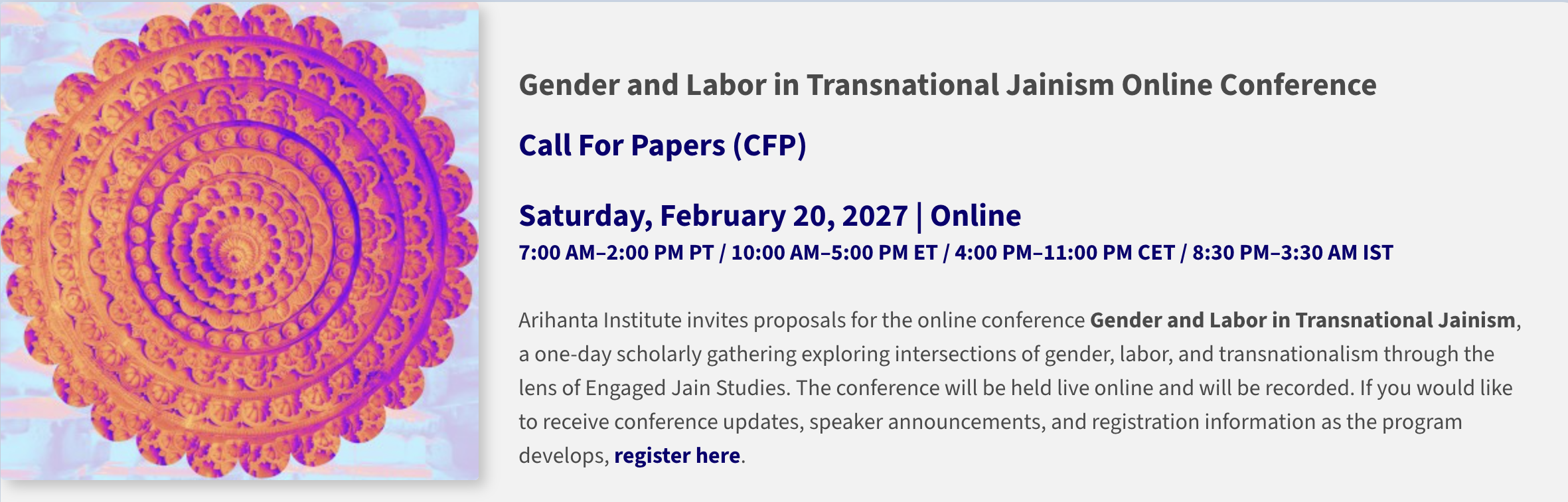
Building on the themes explored in Dr. Rodríguez Gutiérrez's research, Arihanta Institute is pleased to announce the Call for Papers for its upcoming online conference, Gender and Labor in Transnational Jainism, to be held on February 20, 2027. Organized by Dr. Rodríguez Gutiérrez as part of her postdoctoral fellowship at Arihanta Institute, the conference will bring together scholars to examine intersections of gender, labor, food, transnationalism, and lived religion through the interdisciplinary framework of Engaged Jain Studies. Proposals are welcomed from established scholars and graduate students, with abstracts (250 words maximum) due October 15, 2026 and notifications of acceptance to be issued by November 15, 2026. Scholars interested in participating are encouraged to submit a proposal or register to receive conference updates as the program develops.
Works Cited
Atkins, David, Eve Colson-Sihra, and Moses Shayo. 2021. “How Do We Choose Our Identity? A Revealed Preference Approach Using Food Consumption.” The Journal of Political Economy. Volume 129. Issue no.4. 1193–1251.
Marx, Karl; Friedrich Engels. 1952. “Capital”. Manifesto of the Communist Party. Chicago, Ill, Encyclopedia Britannica: Benton.