✔️ Added course to cart

View Cart
Schedule
Learning Area
Instructor
Course Type

14-DAY FREE TRIAL

Subscribe to Arihanta Institute’s Course Membership for unlimited access to our growing library of live and self-paced courses.

Start Your Free Trial

Self-paced
Self-paced

111 | Animal-Centered Design

$99.00 USD
Learn More
Added to cart

111 | Animal-Centered Design

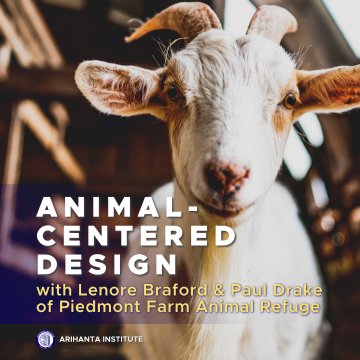
Non-human animals are routinely used for profit or product, and as a result, suffer greatly in our society. Animal sanctuaries provide a glimpse of a different world; one in which animals are provided with protected spaces and treated as equals. A new initiative is taking shape that can aid sanctuaries, and individuals, in their goal of bettering animals' lives: Animal-Centered Design (ACD). In this course you will learn the basic principles of ACD, study examples of it in action within sanctuary settings, and consider how ACD can be applied to companion animals and beyond. This course will also touch on passive solar design, focusing on how proper orientation to the natural elements can benefit both animals and our environment. Readings and assignments are provided throughout the course to engage you directly in the animal sanctuary design process and to inspire you to make a positive change for animals.A portion of the proceeds for this course support Piedmont Farm Animal Refuge.Learning Objectives: Class 1: Introduction to Farmed Animal SanctuariesClass 2: Principles of Animal-Centered DesignClass 3: Precedents in Animal-Centered DesignClass 4: Case Study I-Designing Spaces for GoatsClass 5: Case Study II-Designing Spaces for DucksClass 6: Animal-Centered Design for Companion AnimalsClass 7: Passive Solar Design Strategies for Animal Spaces
$99.00 USD

Instructors

Self-paced

1000 | Foundations of Jain Studies

Open-Access
Learn More
Added to cart

1000 | Foundations of Jain Studies

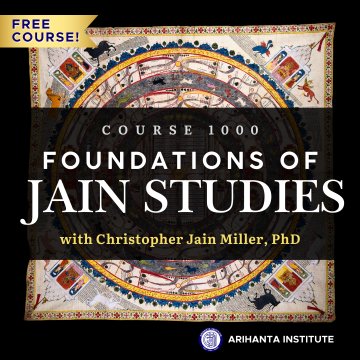
This course offers an introduction to Jain Studies. Begin with an exploration of key Jain teachings and practices, focusing on the principles of non-harming (ahiṃsā) and non-possession (aparigraha), both central to the tradition. Delve, then, into the Three Jewels of Jainism—right worldview, right knowledge, and right conduct—and examine how these principles shape the foundation of the Jain tradition. Next, investigate the profound connection between Jainism and animal advocacy, exploring the teachings of Mahavira on animals as well as contemporary Jain practices of animal care. Afterwards, explore the Jain perspective on the human body, including the importance of health, the role of karmas in shaping one’s embodiment, and the fine line between bodily renunciation and the need to have good health. Finally, observe how Jainism’s commitment to compassion and social justice is expressed through transformative social initiatives, focusing on the work of Acharya Chandanaji and the global reach of her charitable organization, Veerayatan.  Learning Objectives:Understand the core principles of Jainism, including the practices of non-harming (ahiṃsā) and non-possession (aparigraha).Analyze the Three Jewels of Jainism (right worldview, right knowledge, and right conduct).Evaluate the relationship between Jainism and animal advocacy.Learn the Jain perspective on the human body and its role in spiritual practice.Assess the role of compassion and social justice in Jainism.
Open-Access

Instructor

Self-paced

1008 | Jain Responses to Climate Change

Open-Access
Learn More
Added to cart

1008 | Jain Responses to Climate Change

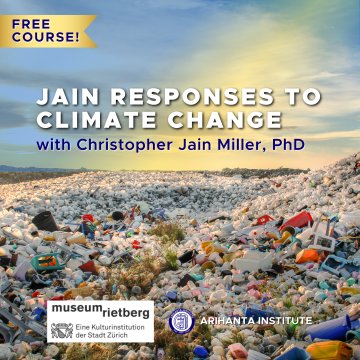
Arihanta Institute is offering this open access course in collaboration with Museum Rietberg, coinciding with their Exhibition “Being Jain: Art and Culture of an Indian Religion” in Zurich, Switzerland.Climate change is arguably the biggest collective challenge human society has ever encountered. But there is hope. Among many of the innovative solutions that have and continue to be proposed, the Jain tradition encourages an environmentally sustainable lifestyle, which, if incorporated into our daily lives worldwide, could have a significant impact in reducing the worst of the climate disaster that is yet to come. Learn the Jain way of life in conversation with some of climate change’s most pressing issues. Leave transformed and empowered to reduce your climate footprint.Class 1Jainism and Ecology: Recognizing the Interconnected Web of LifeLearn how the Jain tradition views the world as an interconnected web of life in which nothing wants to experience pain. Understand how the Jain principle of ahiṃsā, or non-violence, arises from this worldview and some of the fundamental ways you can reduce your carbon footprint by following the Jain way of life and in accordance with climate science.Class 2Jain Approaches to Food: Climate Change & Animal AgricultureThe IPCC (Intergovernmental Panel on Climate Change) recently advised that in light of the effects of animal agriculture on the climate, the entire planet must be “veganised.” Learn, in light of climate science, why animal agriculture is one of the most significant contributors to climate change and environmental degradation. Also study Jain approaches to an ethical and environmentally friendly diet that call into question our unnecessary reliance on animals for food.Class 3Jain Views on Consumption and Waste: A Changing Climate requires Changing HabitsHumans consume food, electronics, fuel and other commodities at rates far beyond what our planet can sustain in the long run and which amount to significant amounts of environmental degradation. Discover what the acceptable limits of consumption are, and also consider Jain ethical approaches to the human behavior of consumption. Be inspired to reconsider your own consumptive habits.Class 4Jain Professional Ethics: Making a Climate-Friendly LivingWe all need to make a living, but what would it mean to make a “climate-friendly” living? Learn Jain ethical approaches to career and professional life, and understand the important connections between the work that you do and its potential effects on the climate. Be inspired to make a righteous living that is good for both you and our climate future.
Open-Access

Instructor

Self-paced
Self-paced
Self-paced

1014 | Jainism, Veganism, and Engaged Religion

$25.00 USD
Learn More
Added to cart

1014 | Jainism, Veganism, and Engaged Religion

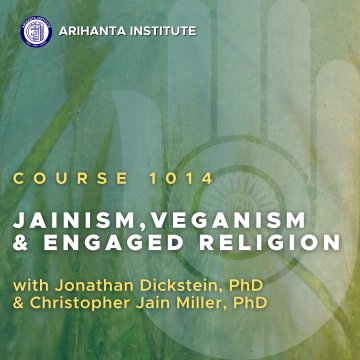
Committed to nonviolence (ahiṃsā) since its ancient beginnings, the Jain tradition has admonished the mistreatment, slaughter, sacrifice, and consumption of animals for thousands of years. In light of these commitments, Jains have traditionally lived a lacto-vegetarian lifestyle, advocated for the legal protection of animals, and have created sanctuaries for animals for centuries. In ancient and medieval scriptural sources, we even find restrictions on the consumption of dairy itself, suggesting potential pre-modern Jain commitments to what would now be referred to as a vegan lifestyle. And today, many Jains have been advocating for veganism in light of the devastating and irreparable harms involved in the production of dairy in contemporary society.  This course carefully considers the philosophical and historical underpinnings of Jain Veganism, presenting an opportunity for non-Jain vegans to discover a rich philosophical system aligned with their values, as well as an opportunity for Jains to appreciate the philosophical resources within their own tradition which naturally lead to living an ethical vegan lifestyle.  Course Details6 hours of recorded lecture contentAdditional readings for self-studyPlus+ 4 x 60-minute recorded Q&A sessions with Professors Dickstein and Miller Student Reviews"Arihanta Institute's course, Jainism, Veganism, and Engaged Religion, is a remarkable example of the transformative power of aligning nonviolence, or ahimsa, with daily living. Professors Miller and Dickstein expertly highlight the Jain tradition, sparking essential conversations about animal agriculture, spiritual practice, and ethically navigating climate collapse. If you're seeking a compassionate path forward, I highly recommend this course. Every week brought a welcoming dialogue with our cohort of students and additional insights from our professors. Thank you, Arihanta Institute!"— Diana H., United States, 2024 “This course exceeded my already-high expectations. Thank you all from the bottom of my heart.”— Agni H., United States, 2024 "I have enjoyed this class, the readings and videos, our discussions, and the meetings with all of you. Thank you all and thank you for this offering Christopher and Jonathan." — Mike A., United States, 2024
$25.00 USD

Instructors

Self-paced

1015 | Debunking the Myth of Sustainable and Humane Animal Agriculture

$25.00 USD
Learn More
Added to cart
Self-paced
Self-paced
Self-paced
Self-paced
Self-paced
Self-paced
Self-paced

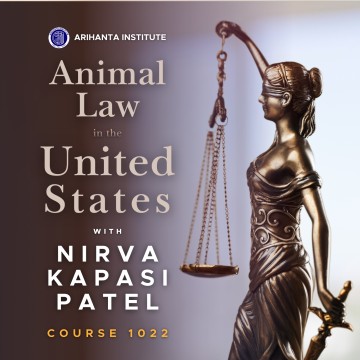
1022 | Animal Law in the United States

$25.00 USD
Learn More
Added to cart

1022 | Animal Law in the United States

In the United States, the law has long treated animals as property and objects to be owned, used, and discarded within human-centered systems. While legal protections against animal cruelty exist, they are often fragmented, riddled with exemptions, and inconsistently enforced. The result is a legal framework that permits immense suffering, particularly for animals used in industrial agriculture, research, and entertainment, while extending comparatively greater protections to companion animals or endangered species.  Over the past several decades, the field of animal law has emerged to interrogate this system, asking not only how animals are treated under the law, but why...and what must change. Animal law challenges the assumption that legal systems are neutral, revealing how they reflect and reinforce hierarchies that privilege human interests, corporate power, and economic efficiency over animal life and well-being. In this course, we will examine key legal frameworks in the U.S. governing the treatment of animals and explore how the law functions both as a tool of oppression and a site for advocacy. Each class focuses on a major theme in contemporary animal law: the foundational classification of animals as property; the regulation (and deregulation) of their use in various industries; the legal distinctions between species and contexts; and the growing efforts to transform legal systems through strategic litigation, rights-based arguments, and cross-movement coalition building. Through this lens, students will be invited to think critically about the role of law in shaping societal values and the possibilities for building a more just, multispecies future. Course Details4 hours of recorded lecture contentAdditional readings for self-studyPlus+ 4 x 60-minute live Q&A Zoom sessions (previously recorded) with Professor Nirva Patel
$25.00 USD

Instructor

Upcoming

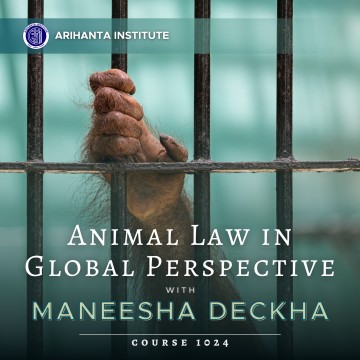
1024 | Animal Law in Global Perspective

Added to cart

1024 | Animal Law in Global Perspective

Legal systems around the world facilitate the exploitation of animals. The results are devastating not only to the animals involved but to people and planetary ecosystems. How can we transform legal systems to reverse this devastation and instead facilitate animal well-being, flourishing, and rights? In this course, Professor Deckha introduces the ideas animal law scholars have advanced to dramatically re-shape legal systems, including her own proposal, advanced in her book Animals as Legal Beings: Contesting Anthropocentric Legal Systems. The course considers the strengths of each proposal as well as their limits. The course uses an intersectional analytic that draws from the feminist animal care tradition, as well as feminist theories of embodiment and relationality, postcolonial theory, and critical animal studies, to compare and contrast proposals inviting learners to consider how the law can move forward for animals in an impactful and non-reductive way despite its anthropocentric foundations. At the end of the course, learners will have a solid understanding of why the law does not protect animals even though it claims to, how this failure is connected to human rights struggles, what legal momentum is currently building for animals around the world, and various contemporary leading proposals as to how to continue to build momentum and transform the law.
Course materials available on Monday, June 1, 2026.

+ Live Q&A on Fridays: June 5, 12, 19, 26 at 9:15-10:15 am PT
$25.00 USD

Instructor

Enrollment Options

ENROLLMENT TUITION

  • $99 one time payment
  • Lifetime access to course
    #### | Name.
Enroll

14-DAY FREE TRIAL

  • Free, unlimited access to our self-paced courses for 14-days.
  • Already used your free trial? Enroll in our Monthly or Annual Membership options at anytime and continue learning immediately!
Start Your Free Trial

MONTHLY MEMBERSHIP

  • $45 USD / Month
  • Immediate access to course
    #### | Name.
  • Unlimited access to our live and self-paced courses for one month, with month-to-month auto rollover.
  • Excludes graduate seminars, language courses, and courses hosted on partner platforms.
Enroll In Membership
Yes
No

Subscribe to
Our Newsletter