
Arihanta Institute’s Self-Paced Course Series and Graduate Seminars at Claremont School of Theology provide undergraduates with opportunities to explore advanced topics in ethics, nonviolence, vegan studies, yoga studies, South Asian traditions, and related fields. These offerings can supplement existing courses, and, in many cases, can be adapted for independent study credit through faculty or departmental approval.
Back To Universities
Graduate Students
SELF-PACED COURSE SERIES
Self-Paced Course Series can be used as primary course material or for enrichment.
- Offered as predefined collections of shorter, academically rigorous courses.
- Primarily asynchronous and self-paced.
- No grades issued, but students may request a certificate upon successful completion.
- Faculty or departments may structure these into credit-bearing independent studies.
Jain Philosophy (90hrs)
Engaged Jainism (98hrs)

Animal Advocacy & Vegan Studies (44hrs)


Yoga Studies (126hrs)
Sanskrit (30hrs, 300 hours including homework)
| Course Number | Course Title | Course Length (hrs) | Instructor | |
|---|---|---|---|---|
| 1 | 2010 | Research Sanskrit: Level 1 | 20 | Cogen Bohanec, MA, PhD |
| 2 | 2011 | Research Sanskrit: Level 2 | 10 | Cogen Bohanec, MA, PhD |
Graduate Seminars
With faculty approval, exceptional undergraduate students may enroll in Arihanta Institute faculty's Graduate Seminars at Claremont School of Theology
- Students must meet the same expectations as graduate-level participants.
- Credit transfer is subject to home institution policies.
Graduate Course
JYST 8001/9001 | Foundations of Jain Yoga Studies
JYST 8001/9001 is a graduate-level seminar offered by Claremont School of Theology (CST). Foundations of Jain Yoga Studies provides students with the historical and philosophical foundations for engaging in the study of Jain yoga. Students will learn about the history of yoga broadly, while also learning core methodologies used to study yoga in the field of Yoga Studies. With this new knowledge and skillset, students will learn how to study Jain yoga and see how it emerged in engagement with other yoga traditions since ancient times and into the present. Upon successful completion of this class, students will be able to:Understand the foundational history and philosophies of yoga.Perform research using core methodologies used in the field of Yoga Studies.See how Jain Yoga emerged in engagement with other traditions using an Engaged Jain Studies methodology.Present their research on Jain Yoga.
Instructor
 Christopher Miller, PhD
Graduate Course
JYST 8004/9004 | Social Justice and Modern Yoga
JYST 8004/9004 is a graduate-level seminar offered by Claremont School of Theology (CST). Social Justice and Modern Yoga surveys the history and contemporary practice of modern yoga and its intersection with issues of social justice. Students will encounter both the major names and lineages in the history of transnational modern yoga as well as some of the lesser-known figures who have contributed to the development of transnational yoga into the present. The course is structured both historically and thematically, presenting topics including, but not limited to, yoga’s intersections with warrior asceticism, colonization, non-violent social justice movements, nationalism, Orientalism, the carceral system, racism, White supremacy, appropriation, gender, foodways, speciesism, pollution, necropolitics, biopolitics, neoliberal capitalism, and abuse. Students will be trained in the basic methods of writing yoga ethnography and social history and will complete an ethnographic research project on a topic of their choice related to the academic field of Modern Yoga Studies. Upon successful completion of this class, students will be able to:Understand central historical developments of transnational modern yoga.Understand how particular forms of modern yoga are entangled with particular issues of social justice.Perform and present the results of basic ethnographic fieldwork or social historical research pertaining to a contemporary yoga community with particular attention to an issue of social justice.Gain a working knowledge of some of the major issues and questions in the field of Modern Yoga Studies. Student Reviews"Learning from Dr. Miller was an incredible gift. His wisdom and knowledge of these topics are so helpful." — Graduate Student, Claremont School of Theology, 2024 “Dr. Miller is a tremendous resource of information. His style of teaching is helpful, conversational, and inclusive. I appreciate how he asked the class questions and got us thinking in new ways. I would highly recommend this course.” — Graduate Student, Claremont School of Theology, 2024 "The prerecorded lectures that Professor Miller shared before each class were very helpful. For a working professional like me this was a big relief!” — Graduate Student, Claremont School of Theology, 2024 “Dr. Miller's passion for the topics came through in all classes and lectures.” — Graduate Student, Claremont School of Theology, 2024 “It was great to have students from other institutes to learn with. Continuing this is important for global perspectives.” — Graduate Student, Claremont School of Theology, 2024 “Dr. Miller is a tremendous resource of information. His style of teaching is helpful, conversational, and inclusive. I appreciate how he asked the class questions and got us thinking in new ways. I would highly recommend this course.” — Graduate Student, Claremont School of Theology, 2024
 Fall 2025 (September 2 – December 8, 2025)
Thursday 8:00 - 10:50 a.m. PT
Instructor
Graduate Course
JYST 8003/9003 | Haṭha Yoga & Jain Yoga
Added to cart
JYST 8003/9003 | Haṭha Yoga & Jain Yoga
JYST 8003/9003 is a graduate-level seminar offered by Claremont School of Theology (CST). The “Haṭha Yoga and Jain Yoga” course carefully considers the development of the haṭha yoga tradition, the medieval forms of yoga that emerged after India’s classical period, and which are the predecessors of today’s forms of physical yoga. Students are offered the opportunity to undertake the postural, breathing, and meditation techniques found in medieval haṭha yoga texts as well as to see how these texts influenced, or were perhaps influenced by, the Jain yoga tradition in particular. Upon successful completion of this class, students will be able to:Understand the historical development and context of haṭha yoga traditions, including their medieval and modern Jain forms.Analyze intertextual engagements between haṭha yoga texts and Jain yoga texts.Engage in primary postural, breathing, and meditation techniques from medieval haṭha yoga texts.Undertake and present their research in the field of Yoga Studies and Engaged Jain Studies with a particular focus on haṭha yoga traditions.
Spring 2026 (January 26 – May 4, 2026)Thursday 8:00 - 10:50 a.m. PT
Instructor
Graduate Course
LGUJ 8001/9001 | Modern Gujarati 1
Added to cart
LGUJ 8001/9001 | Modern Gujarati 1
Embark on an immersive journey into the vibrant world of Gujarati language and literature. This first-semester course, part of a two-semester sequence (Modern Gujarati 1 & 2), focuses on developing Gujarati language skills as a research tool for translating the vast and diverse tapestry of Gujarati literature. Through a structured approach based on the Pedagogical Ladder framework (incremental skill development), we will explore the fundamentals of modern Gujarati grammar, vocabulary, and language structure. This foundational knowledge will enable students to develop research skills for translating modern Gujarati texts and lay the groundwork for future studies in spoken Gujarati and pre-modern Gujarati texts. This class, over the course of two semesters, aims to provide a comprehensive understanding of the Gujarati language, focusing on both script and grammar. Students will delve into the Gujarati script, learning proper reading and writing techniques. The curriculum will cover essential grammatical concepts such as pronouns, cases, and nominal inflections, with an emphasis on understanding grammatical gender and plural forms. Students will also be introduced to various verbal tenses, along with negation and politeness in communication and other idiomatic forms. The course will build on these foundational topics by exploring increasingly complex grammatical structures and syntaxes. In addition to learning language skills, our course will informally cover various cultural, religious, and philosophical points regarding Gujrati culture, history, and traditions. We will discuss the rich cultural history of Gujarati literature, spanning from its origins in 12th-century religious and epic poetry to its modern forms. We will study the language's adaptation through influences from Jain scholars, the Bhakti movement, and Western education. By the end of this course, students will have acquired: Comprehensive understanding of half of the necessary Gujarati grammar.Strategies for fostering deeper understanding and mastery of skills required to translate Gujarati sources.Familiarity with the Pedagogical Ladder framework and its application to language acquisition. Insight into the cultural and historical context of Gujarati literature. This course is ideal for: Students of South Asian traditions and dharma religions (Jain, Hindu, and Buddhist).Researchers interested in Gujarati language and literature.Students of South Asian language and linguistics.Anyone fascinated by the rich cultural heritage of Gujarat.
Instructors
 Cogen Bohanec, MA, PhD
 Venu Mehta
Graduate Course
LGUJ 8002/9002 | Modern Gujarati 2
Added to cart
LGUJ 8002/9002 | Modern Gujarati 2
This course will continue our immersive journey into the vibrant world of Gujarati language and literature with this second-semester course in the two-semester sequence (Modern Gujarati 1 & 2). This course builds upon the foundation laid in the first semester, focusing on advancing your Gujarati language skills as a research tool for translating the vast and diverse tapestry of Gujarati literature. Through a structured approach based on the Pedagogical Ladder framework (incremental skill development), we will delve deeper into the intricacies of modern Gujarati grammar, vocabulary, and language structure. This advanced knowledge will enable students to further develop research skills for translating modern Gujarati texts and prepare for future studies in spoken Gujarati and pre-modern Gujarati texts. This second semester course offers an in-depth exploration of Gujarati language structures and grammatical features, focusing on advanced pronouns, negation forms, adjectives, adverbs, participles, gerunds, and complex verbs. The curriculum is designed to enhance linguistic proficiency by examining passive voice, causatives, relative and correlative constructions, and expressions of necessity. Students will also delve into special grammatical cases and conversational techniques, with an emphasis on cultural contexts and idiomatic expressions. The semester concludes with a comprehensive review and assessment, ensuring students are well-equipped with advanced conversational skills and a deep understanding of Gujarati language nuances. In addition to enhancing language skills, our course will continue to cover various cultural, religious, and philosophical aspects of Gujarati culture, history, and traditions. We will further explore the rich cultural history of Gujarati literature, examining its progression from its origins in 12th-century religious and epic poetry to its modern forms. We will study the language's adaptation through influences from Jain scholars, the Bhakti movement, and Western education. By the end of this course, students will have acquired:Comprehensive understanding of advanced Gujarati grammar.Strategies for mastering skills required to translate Gujarati sources with greater accuracy.Enhanced familiarity with the Pedagogical Ladder framework and its application to advanced language acquisition.Deeper insight into the cultural and historical context of Gujarati literature. This course is ideal for:Students of South Asian traditions and dharma religions (Jain, Hindu, and Buddhist).Researchers interested in advanced studies of Gujarati language and literature.Students of South Asian language and linguistics.Anyone passionate about the rich cultural heritage of Gujarat.
Instructors
Graduate Course
JPHA 8001/9001 | Introduction to Jainism: Non-violence as a Way of Life
JPHA 8001/9001 is a graduate-level seminar offered by Claremont School of Theology (CST). This course provides an introduction to Jainism in India with a focus on the three “B”s—Belief, Behavior, Belonging. The course surveys the emergence of Jainism in ancient India, the life and teachings of Lord Mahavira, the ascetic and lay aspects of Jain society, Jain philosophy and ethics, and religious practices such as vegetarianism, fasting, and worship. The course lends particular emphasis to the ethic of ahiṃsā (non-violence) and its implications for contemporary Jain animal ethics and environmentalism. Upon successful completion of this class, students will be able to:Chart the historical development of Jainism in India.Identify the major features of Jain philosophy.Connect Jain philosophy to Jain practice, both ritual and ethical practice (“Applied Jainism”).Describe Jainism as a lived religion with its contemporary lived communities and aspects.Describe ethical contestations within Jain communities as they engage current issues such as feminist critique, consumer capitalism, industrial agriculture, climate collapse, and social justice writ large.
Fall 2025 (September 2 – December 8, 2025)Wednesday 8:00 - 10:50 a.m. PT
Instructor
 Jonathan Dickstein, PhD
Graduate Course
VGST 8002/9002 | Jain Veganism in the History of Global Veganism
VGST 8002/9002 is a graduate-level seminar offered by Claremont School of Theology (CST). This course provides a historical overview of plant- (and non-plant-) based living from a regional perspective. Tracing the emergence and development of plant-dominant, vegetarian, and vegan diets in Asia, Africa, Europe, and the Americas, the course foregrounds the cultural, religious, and geographic factors behind these—as well all adjacent and alternative—consumption patterns. Pivoting from the regional to the global, the course then explores the emergence of transnational veganism and how Jain veganism fits in this modern phenomenon. Upon successful completion of this class, students will be able to:Locate significant features of international food patterns.Identify cultural and historical food trends and their relationships to economics and politics.Connect Jain and Non-Jain philosophies to food practices (“Engaged Religion”).Understand relationships between religion, the body, and consumption.Describe the intricacies of the Jain diet, past and present. Student Reviews“I appreciated the breadth and depth of the topic! More than any material I've yet consumed or classes I've taken, this course changed my ideas on what "vegan" means - for the better. I gained more cultural literacy and conversational competencies, which then created a direct positive effect on my daily and activist life. This course is truly fantastic and I appreciated it a great deal.”— Graduate Student, Claremont School of Theology, 2024 “All the materials and assignments were interesting, I looked forward to this course a great deal every single week. I appreciated the global and historical perspective and I think this course would be a fantastic introduction for anyone interested in animal studies, veganism, animal rights, and/or cultural foodways. ” — Graduate Student, Claremont School of Theology, 2024
Instructor
Graduate Course
JPHA 8002/9002 | Jain Philosophy
Added to cart
JPHA 8002/9002 | Jain Philosophy
JPHA 8002/9002 is a graduate-level seminar offered by Claremont School of Theology (CST). This course is a study of Jain philosophy grounded in the practical and moral imperatives of non-violence and compassion. Students will learn how non-violence and compassion emerge from the intricate system of Jain ontology, metaphysics, cosmography, epistemology, ethics, and soteriology. Historical context for the development of Jain philosophy in relation to other South Asian philosophical systems is included, while students will also integrate their learning into their personal, social, and/or professional lives today. samyag-darśana-jñāna-caritrā-mokṣa-mārgaḥ“Correct worldview, correct knowledge, and correct conductcomprise the path to liberation.”– Tattvārtha-Sūtra 1.1 Upon successful completion of this class, students will be able to:Articulate Jain ontology, metaphysics, cosmology, epistemology, ethics, and soteriology.Understand the historical development of Jain philosophy in relation to other South Asian philosophical systems.Demonstrate integration of Jain philosophy into their personal, social, and/or professional lives.
Instructor
Graduate Course
VGST 8003/9003 | Food Politics in South Asia & Beyond
VGST 8003/9003 is a graduate-level seminar offered by Claremont School of Theology (CST). This course delves into the intricate dynamics of food practices, systems, and politics in South Asia, with a particular emphasis on India's diverse religious, regional, class, and caste groups. It aims to foster a nuanced understanding that food is never merely sustenance but serves as a potent vehicle for constructing and expressing individual, familial, regional, and even national identities, with profound social and often discriminatory consequences. The course begins with an exploration of religious perspectives on food production, preparation, consumption, and commensality, focusing on dietary prescriptions and proscriptions in Jainism, Hinduism, Buddhism, and Islam. From there, the content transitions to contemporary issues, events, laws, and policies that illustrate how food is weaponized in projects of social demarcation and oppression. Key topics include the rise of vegetarian Hindu nationalism, the pure/impure dichotomy, gender and "women's work," colonial influence on production and consumption, the contemporary Westernization of South Asian foodways, “peasant” resistance movements, and the differentially-impactful ecological ramifications of increasingly industrialized food systems. The course culminates with a brief discussion of specific gastropolitical debates in Central, East, and Southeast Asia, as well as in the South Asian diaspora in North America, providing a comparative and transnational perspective. Upon successful completion of this class, students will be able to:Describe (with examples) how integral food is to identity formation.Locate significant features of regional food politics.Identify the intersections of religion, gender, race, class, and caste in conflicts around food production and consumption.Compare and contrast Jain, Hindu, Buddhist, Sikh, Muslim, and Christian foodways.Discuss the impacts of colonialism, Westernization, and industrialization on South Asian food systems.
Instructor
Graduate Course
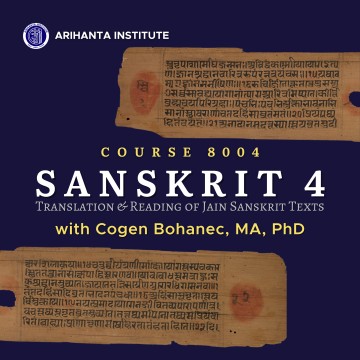
8004 | University Sanskrit 4: Translation & Reading of Jain Sanskrit Texts
This advanced Sanskrit course is a direct continuation of University Snskrit 3 and forms part of Arihanta Institute’s ongoing faculty–student research project on Hemacandra’s Yoga-śāstra and its Svopajña-vivaraṇa commentary. Designed for students who have completed a foundational first-year Sanskrit sequence and can read intermediate prose and verse texts, the course applies grammatical and interpretive knowledge to the translation and analysis of this seminal Jain treatise. Through the close reading of Yoga-śāstra passages and their commentarial explanations, students deepen their understanding of Sanskrit syntax, Jain philosophical vocabulary, and classical scholastic style while situating the text within broader South Asian intellectual traditions. In addition to its focus on Jain philosophy and hermeneutics, the course provides a linguistic foundation for understanding the evolution of Indo-Aryan languages. Mastery of Sanskrit at this level equips students for further study of the Middle Indo-Aryan Prakrits, Apabhraṃśas, and later vernaculars—languages that are central to the study of Jain and wider South Asian literary traditions. Emphasis is placed on developing publication-quality translation and research skills, integrating philological precision, hermeneutic awareness, and critical engagement with primary and secondary sources. By participating in a collaborative academic environment—where faculty and students contribute to an evolving body of Jain Studies scholarship—students refine their ability to produce rigorous, well-annotated translations suitable for conference presentation or publication. The course culminates in an independent research paper demonstrating mastery of Sanskrit language and commentarial analysis within the context of Hemacandra’s thought and Jain philosophy more broadly. This course is not offered directly for university credit from Arihanta Institute. However, students who wish to receive language credit from their home institutions (including the MA in Engaged Jain Studies at Claremont School of Theology) are encouraged to contact their administrations to explore the possibility of having this course count toward academic credit through their home institutions. Many universities, particularly at the graduate level, provide mechanisms such as a “special reading course,” “directed reading course,” or other forms of independent study that allow students to work with a faculty member at their institution to tailor a course to their specific needs. In the past, Arihanta Institute students have successfully arranged with their home institutions to take our language classes for university credits from their home institutions under such frameworks, with our instructors providing the final grade and grading rubric directly to their institution. If you are interested in pursuing academic credit in this way, please consult with your home institution’s administration about the available options, and Dr. Bohanec will be happy to work with them to submit your grade for the course to them. Learning ObjectivesDevelop advanced Sanskrit reading, translation, and philological skills, demonstrating mastery of complex grammar, syntax, and vocabulary through accurate and idiomatic renderings of primary texts.Analyze and interpret Sanskrit commentarial literature with attention to Jain philosophical frameworks—particularly Hemacandra’s Yoga-śāstra and Svopajña-vivaraṇa—while engaging in comparative hermeneutic dialogue with Hindu and Buddhist traditions.Apply linguistic and hermeneutic methods to assess philosophical arguments, religious language, and the structure of commentarial reasoning in premodern South Asian texts.Situate Jain philosophical texts within broader South Asian and global intellectual traditions, including comparative study of dharmic and Abrahamic perspectives on ethics, epistemology, and contemplative practice.Discuss and critique nuances in South Asian philosophy, theology, linguistics, literature, and culture, demonstrating both technical precision and interpretive depth.Produce publication-quality translation and research projects, integrating philological analysis, hermeneutic reflection, and ethical awareness appropriate to graduate-level scholarship. Presented by the Center for South Asian Languages (CSAL) at Arihanta Institute.
Spring 2027
$500.00 USD
Instructor
Graduate Course
VGST 8004/9004 | Veganism, Climate Change, and Environmental Justice
Course VGST 8004/9004 is a graduate-level seminar offered by Claremont School of Theology (CST). This interdisciplinary course explores the intersections between veganism, climate change, and environmental justice. It considers veganism not merely as a dietary or lifestyle choice, but as a political and ecological practice. Through philosophical, scientific, and activist perspectives, students will interrogate the environmental impacts of animal agriculture, the racialized and classed dimensions of climate vulnerability, and the transformative potential of food systems rooted in justice and care. Learning ObjectivesGain a basic understanding of the origin, history, and applications of veganism both regionally and globally.Understand the main features of the global climate crisis and their relationship to industrial food systems.Connect climate crisis to differential climate vulnerability, or how environmental consequences impact populations differently due to race and class-based discrimination.Understand the basis tenets of environmental justice, with respect to animal-based industries in particular.Deploy tools for constructive dialogue across cultures and religions regarding veganism, climate change, and environmental justice.
Spring 2026 (January 26 – May 4, 2026)Thursday 8:00 - 10:50 a.m. PT
Instructor
Graduate Course
8002 | University Sanskrit 2 Live
Added to cart
8002 | University Sanskrit 2 Live
This course is Part 2 of 2 in the University Sanskrit sequence. Building on the language foundations established in University Sanskrit 1, students will complete the remaining portion of the Devavāṇīpraveśikā Sanskrit primer (Goldman and Goldman, 1980) and consolidate their command of the core grammatical systems required for reading and translating Sanskrit texts. Through sustained memorization, recitation, and guided translation practice, students will learn to recognize, recall, and apply all major paradigms of inflection, including nominal declensions, verbal conjugations, participial formations, compounds, indeclinable suffixes, and key syntactic constructions. Students will further develop essential research skills in Sanskrit philology, including attention to grammatical form, syntactical analysis, and disciplined translation practice, by translating modified excerpts from Sanskrit literature. Competency in Sanskrit translation is a central research skill for scholars in South Asian Studies, providing direct access to primary sources and supporting credibility in academic writing. At the same time, Sanskrit study can also deepen engagement with lived religious traditions. For many dharma traditions—particularly Jainism, Hinduism, and Buddhism—Sanskrit functions as a primary medium of liturgy, doctrine, and philosophical reflection. As such, this course supports both academic research preparation and informed engagement with the cultural, intellectual, and spiritual landscapes shaped by Sanskrit texts. By the end of this course, students will have completed the Devavāṇīpraveśikā primer in full and will be prepared to advance to more independent translation and textual study at the upper-division undergraduate or graduate level. Learning Objectives1. Learn to read Sanskrit in Devanagari font.2. Acquire basic Sanskrit vocabulary.3. Learn to identify and understand the basic grammatical forms covered in class.4. Learn to understand key differences between Sanskrit and English syntaxes and to be able to convert Sanskrit syntax into English syntax.5. Learn basic skills for translation of Sanskrit primary sources for research6. Become familiarized with other cultural and intellectual elements of the broader Sanskrit tradition. Presented by the Center for South Asian Languages (CSAL) at Arihanta Institute.
Coming Spring 2027. The seminar meets: Mondays 8:00 - 9:25 am / Wednesdays 8:00 - 9:25 a.m., Pacific (PST)
$500.00 USD
Instructor
Graduate Course

8005 | University Sanskrit 1 & 2 Summer Intensive
Added to cart
8005 | University Sanskrit 1 & 2 Summer Intensive
This course is an eight-week summer intensive that integrates University Sanskrit 1 and University Sanskrit 2 into a single, accelerated sequence. Designed for students seeking immersive language training, the course covers the full scope of the Devavāṇīpraveśikā Sanskrit primer (Goldman and Goldman, 1980), moving from foundational grammatical systems to more advanced forms required for sustained reading and translation of Sanskrit texts. Through daily instruction, sustained memorization, recitation, and guided translation practice, students will learn to recognize, recall, and apply the major paradigms of Sanskrit inflection, including nominal declensions, verbal conjugations, participial formations, compounds, indeclinable suffixes, and key syntactic constructions. Emphasis is placed on disciplined study habits and cumulative mastery, with the understanding that the accelerated pace of a summer intensive requires consistent engagement and regular review. Students will develop essential research skills in Sanskrit philology, including close attention to grammatical form, syntactical analysis, and methodical translation practice, by translating carefully selected and modified excerpts from Sanskrit literature. While the course moves more rapidly than a standard academic-year sequence, instructional pacing is intentionally structured to provide initial orientation and methodological grounding, followed by a period of accelerated coverage and a final phase of consolidation and integration. Competency in Sanskrit translation is a central research skill for scholars in South Asian Studies, providing direct access to primary sources and supporting credibility in academic writing. At the same time, Sanskrit study can also deepen engagement with lived religious traditions. For many dharma traditions—particularly Jainism, Hinduism, and Buddhism—Sanskrit functions as a primary medium of liturgy, doctrine, and philosophical reflection. Accordingly, this course supports both academic research preparation and informed engagement with the cultural, intellectual, and spiritual landscapes shaped by Sanskrit texts. By the end of the intensive, students will have completed the Devavāṇīpraveśikā primer in full and will be prepared to advance to more independent translation and textual study at the upper-division undergraduate or graduate level, including advanced 8003 | Sanskrit 3 and 8004 | Sanskrit 4 coursework. Presented by the Center for South Asian Languages (CSAL) at Arihanta Institute.
- June 15 – August 7, 2026
- Monday - Friday, 5:00 - 7:15 p.m. Pacific
- 90 hours online, equivalent to two full semester courses
$750.00 USD
Instructor
Graduate Course
LGER 8001 | German for Reading and Translation in the Study of Religion
A significant amount of Indological scholarship considering the Jain tradition was written in German, making learning German for the study of Jainism a critical research skill. In this graduate course, students will learn the German grammar necessary to begin to confidently read and translate German texts, with the goal of preparing them to undertake advanced translation and/or pass their competency exams. Students will also learn to appreciate reading and translation as a personally transformative practice supported through, though irreplaceable by, artificial intelligence.One particularly unique feature of this course is its ongoing engagement with thebiography of artist Narendra Kumar Jain. Class exercises will focus on translatingGerman newspaper articles, interviews, and other media discussing Jain’s journey from India to Germany where he painted a mural on the Berlin Wall’s East Side Gallery.Through their translations, students will appreciate how his mural, titled The SevenStages to Enlightenment (Die sieben Stufen der Erleuchtung), emerges out of a richhistorical context where Jain and yogic values intersect with international politicsmanifesting in post-World War II Berlin. Course objective:The objective of this course is that students will be able to demonstrate proficiency inreading and translating German in academic and journalistic works, for the study ofreligion. Presented by the Center for South Asian Languages (CSAL) at Arihanta Institute.
Summer 2026
Instructor
Current University Collaborations